Food & Beverage Manufacturing Wastewater Treatment Solutions

Food and beverage manufacturing generates wastewater that may push past what municipal systems are designed to treat without pretreatment support. The volumes are high and the organic loads are intense, with pH swinging wildly depending on what’s being processed and whether sanitation is mid-cycle. The regulatory framework requires navigating multiple overlapping authorities simultaneously: FDA requirements, EPA pretreatment standards, and local sewer district limits that vary by jurisdiction and rarely agree with each other.

Getting wastewater treatment wrong creates problems that cascade: discharge violations, sewer surcharges eating into margins, and production slowdowns that ripple through the schedule. Facilities that run smoothly have learned to manage their wastewater as a core operational function, not an afterthought, because proper treatment protects both the operation and the environment it’s part of.

Understanding Food & Beverage Wastewater

Municipal treatment plants are designed around domestic sewage as their baseline. What comes out of a food processing facility carries significantly higher organic loads, wider pH variability, and more unpredictable flow patterns than that baseline accounts for.

Processing operations generate the bulk of it: washing raw materials, cooking, cooling, and packaging. These all produce water heavy with organic matter and the composition shifts based on what’s running through the line that day. Cleaning and sanitation add another layer: CIP (clean-in-place) systems, floor washing, and equipment sanitization contribute significant volumes with variable chemical composition, including the caustic and acidic agents that make pH so unpredictable. Cooling systems bring their own contribution, potentially picking up lubricants and other contaminants from the processing equipment they serve.

What makes food and beverage wastewater distinctive is how these characteristics combine. Biochemical oxygen demand (BOD) and chemical oxygen demand (COD) run extremely high compared to municipal wastewater. Organic solids create loading issues that accumulate over time and pH can fluctuate from acidic to alkaline shift as products move through the line and cleaning chemicals cycle through the system.

Volume compounds the challenge when peak flows during washdowns and shift changes can overwhelm systems sized for average conditions. A facility might discharge relatively little during production hours and then release a surge when sanitation crews come through. Any treatment program built around averages can fail at the moments that matter most.

Regulatory Requirements for Food & Beverage Facilities

There are two sets of rules, often different in their specifics, and businesses are responsible to make sure they meet them. That’s the regulatory reality for food and beverage facilities managing wastewater discharge.

Federal pretreatment standards from the EPA establish baseline requirements for what can be discharged into publicly owned treatment works (POTWs). These standards exist because industrial-strength discharge at the concentrations food processing generates can overwhelm municipal treatment processes without intervention. High BOD loads can overload biological treatment, solids can accumulate in sewer lines and pH extremes damage infrastructure and kill the microorganisms that make treatment work.

Local sewer districts typically impose limits stricter than the federal floor, with BOD caps in the form of total suspended solids (TSS) limits. Discharge permits that specify monitoring requirements, sampling frequencies, and reporting obligations are needed for local sewer districts. The specifics depend entirely on your local authority, which means a facility in one jurisdiction can face different limits than an identical operation twenty miles away.

The penalties for non-compliance go beyond fines. Repeated violations can trigger increased monitoring requirements, mandatory pretreatment system installation, or revocation of the discharge permit entirely. Some facilities have faced production shutdowns when their discharge problems became severe enough to threaten the POTW’s own compliance.

Crystal Clean works within this regulatory framework with documentation and reporting support built into the service relationship. When discharge characteristics shift because of a new product line, seasonal production changes, or tightening local limits, having a partner who understands both the technical treatment side and the regulatory reporting side turns those adjustments into operational transitions, avoiding compliance crises.

Treatment Solutions for Common Challenges

What works for one waste stream won’t always work for another. The treatment approach has to address each challenge on its own terms while accounting for how they interact in your facility.

High-Strength Organic Waste

The BOD and COD levels in food processing wastewater routinely exceed what sewer districts will accept without pretreatment or surcharges. A dairy operation or brewery can easily generate wastewater with BOD levels 10 to 20 times higher than domestic sewage. At those concentrations, discharging without pretreatment risks overwhelming your local POTW’s biological processes and triggering surcharges or violations.

Reducing organic loading requires either on-site pretreatment or removal of high-strength waste streams before they enter the sewer system. There are several options, such as biological treatment that uses microorganisms to break down organic matter or chemical treatments which can precipitate solids and reduce loading. The right approach depends on your waste characteristics, volumes, and local discharge limits.

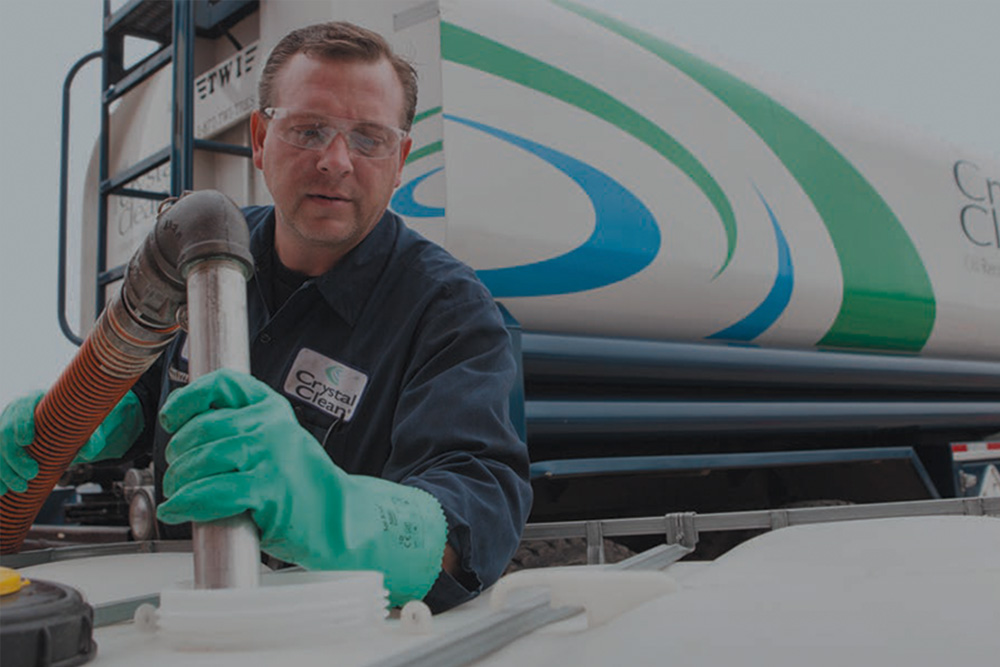
Crystal Clean has a wastewater management program which can remove high-strength liquid waste streams via vacuum truck for off-site treatment at Crystal Clean’s own permitted treatment facilities. This reduces the organic load in your discharge and shifts the treatment burden to facilities specifically designed and permitted to handle it.

pH Control and Neutralization

Food processing involves acids and bases that create pH swings in wastewater throughout the day. Things like, citric acid from fruit processing, caustic cleaners from CIP systems, the discharge might be acidic one hour and alkaline the next, depending on where you are in the production and sanitation cycle.

Sewer systems cap pH for good reason. Extreme levels damage pipes, disrupt treatment biology, and can release toxic gases in confined spaces. Facilities need either equalization basins to blend flows and moderate pH, or active neutralization systems that adjust pH before discharge.

For batches of strongly acidic or alkaline wastewater that can’t be safely neutralized and discharged on-site, Crystal Clean’s vacuum truck services remove them for proper treatment at permitted facilities, keeping your discharge within limits without the risk and complexity of attempting on-site neutralization.

Solids Separation and Sludge Removal

Removal options include screens, settling tanks, and clarifiers to capture organic solids before they reach the sewer system. These systems work continuously until the solids accumulate to the point where they need removal, and they lose effectiveness gradually enough that the decline isn’t always obvious until discharge numbers start climbing.

The material that accumulates is typically a liquid or semi-solid slurry rather than dry solids. Crystal Clean’s vacuum trucks handle these applications. We remove accumulated sludge from settling tanks and clarifiers, transporting it for proper treatment, and restoring the system to full capacity. This applies to liquid and sludge waste streams; food solids that are managed separately require containerized disposal.

Every food and beverage operation is different. What a beverage producer generates looks nothing like what comes out of a meat processing line. Seasonal operations create spikes and lulls that year-round facilities never see. Crystal Clean builds custom treatment programs around each facility’s reality rather than applying a template that fits no one well.

Facility Storage Space is Running Short

Liquid waste consumes more floor space than the drums themselves. Secondary containment takes square footage, spill response clearance takes additional space for safety protocols, and positioning decisions must account for worst-case scenarios.

Then there’s the safety dimension. Liquid waste accumulation creates slip hazards around storage areas, drum failures or leaks expose workers to materials they shouldn’t come into contact with, or fumes can accumulate in enclosed spaces. The longer liquid waste sits, the more these risks compound. Facility managers who track inventory, manage traffic flow, and plan emergency response all have to work around the liquid waste footprint.

Crystal Clean offers reliable, flexible pickup scheduling for liquid wastes, so waste moves out on a timeline that works for operations rather than racing against storage capacity or containment limits. This helps your facility become cleaner, more organized, and safer to navigate.

Choosing the Right Treatment Partner

Call a general waste services company about food processing wastewater, and you might come away with more questions than answers. The contaminants are different, the regulatory framework involves food safety considerations alongside environmental compliance. Production schedules and sanitation requirements create operational rhythms that differ significantly from standard industrial facilities.

Industry expertise matters here. A partner who understands the connection between your sanitation schedule and your wastewater profile can anticipate problems a generalist might miss. That understanding comes from working inside food and beverage operations, not from reading about them.

24/7 availability isn’t optional. When your separator backs up or your settling tank overloads, sanitation stops. When sanitation stops, production stops. Response time in food and beverage processing carries a cost that it simply doesn’t in a facility running one shift with no food safety obligations.

Fleet capabilities need to match the work. Routine separator maintenance needs a smaller vacuum truck unit. Tank cleanouts and sludge removal need more capacity. A provider handling food and beverage facilities needs both, plus the flexibility to handle scheduled service and emergency calls with the same level of expertise.

Where does the waste go? Crystal Clean operates its own regional wastewater treatment facilities designed to treat industrial waste streams. Discharge from these facilities meets EPA, state, and POTW standards. Manifests, service records, and treatment verification create the chain of custody that proves proper handling when auditors or regulators come through.

Partner With Crystal Clean

Between organic loading, pH volatility, solids accumulation, and discharge limits that vary by jurisdiction, food and beverage facilities carry a wastewater burden that most industries never have to think about. Managing all of it simultaneously while keeping production moving is the job.

Crystal Clean handles vacuum services, treatment at our own permitted facilities, and compliance documentation under one program. Scheduled service prevents problems. Emergency response addresses them when prevention falls short. And complete documentation means you’re ready when auditors arrive, not scrambling to reconstruct a paper trail.

Your operation deserves a partner who doesn’t need the twenty-minute explanation.

Contact Crystal Clean for a free waste assessment. Our team will evaluate your waste streams and recommend the right solidification approach for your operation.

Crystal Clean Re-Refined Products

At Crystal Clean, sustainability and innovation work hand in hand. Our state-of-the-art oil re-refinery in Indianapolis, Indiana, is permitted to process up to 75 million gallons of used oil each year, transforming it into high-performance fuels and base oils that support a wide range of industries.

From lubricant blenders and asphalt producers to industrial manufacturers, Crystal Clean’s re-refined products deliver the performance, reliability, and consistency our customers depend on while supporting a cleaner and more sustainable future.

LDF – Light Distillate Fuel

Light Distillate Fuel (LDF) is a clean-burning fuel used across industrial and manufacturing applications. As a recycled, renewable product, LDF provides dependable energy output while helping customers reduce their reliance on virgin petroleum.

By capturing value from used oil, Crystal Clean’s LDF turns a potential waste stream into a practical, sustainable energy resource.

VTAE – Vacuum Tower Asphalt Extender

Vacuum Tower Asphalt Extender (VTAE) is a heavy, viscous product used in asphalt blending and road construction. It enhances pavement flexibility, durability, and performance, making it a preferred choice for asphalt manufacturers seeking a reliable, cost-effective solution.

VTAE replaces traditional virgin asphalt extenders with a re-refined alternative that lowers environmental impact without compromising quality to support a more sustainable infrastructure.

HTLF – Hydrotreated Low Flash Fuel

In Crystal Clean’s Hydrotreater Unit (HT), Hydrotreated Low Flash Fuel (HTLF) is produced as part of the re-refining process that upgrades Vacuum Gas Oil (VGO). This light, refined fuel is highly flammable and offers clean combustion with minimal odor, making it well-suited for industrial heating and blending applications.

HTLF delivers consistent performance while helping businesses minimize emissions and meet modern efficiency standards.

HTLS – Hydrotreated Low Sulfur Fuel

Hydrotreated Low Sulfur Fuel (HTLS) is anothe25198r fuel product from the Hydrotreater that meets stringent environmental requirements. With a significantly reduced sulfur content, HTLS provides an environmentally responsible option for commercial and industrial use.

Its stability and cleanliness make it ideal for customers seeking a balance between performance and compliance with clean fuel standards.

HCC 80 – Group II Base Oil

Crystal Clean’s HCC 80 Group II Base Oil is a mid-viscosity, high-purity base oil designed for use in a wide range of lubricants — from industrial fluids to automotive and marine formulations. It offers excellent oxidation stability, low volatility, and superior cleanliness, ensuring long-term performance and reliability.

With its consistent properties and compatibility with major additive systems, HCC 80 helps lubricant blenders create finished products that meet demanding operational standards.

HCC 150 – Group II Base Oil

Our flagship HCC 150 Group II Base Oil delivers the highest quality and consistency, exceeding major industry standards — including API SP, ILSAC GF-6, and API CK-4/SM when blended with additives from leading suppliers.

Beyond performance, HCC 150 represents a significant environmental advantage. A third-party verified study by ClimeCo found that Crystal Clean’s HCC 150 re-refined base oil has a 77% lower greenhouse gas footprint compared to virgin base oil. By choosing HCC 150, customers gain a proven, sustainable alternative that performs to the highest specifications while supporting carbon reduction goals.

Quality, Performance, and Responsibility in Every Product

Every Crystal Clean product undergoes rigorous laboratory testing to ensure it meets or exceeds industry specifications. Our focus on quality, reliability, and customer satisfaction means every gallon we produce supports the highest standards of performance and environmental stewardship.

From fuels that power industry to base oils that drive efficiency and sustainability, Crystal Clean’s re-refined products are transforming how businesses think about resource recovery.

Learn more about how Crystal Clean’s re-refined products can support your blending, manufacturing, and sustainability goals and join us in advancing a cleaner, smarter future.

Contact Us

5 Signs Your Business Needs Professional Non-Hazardous Waste Solidification Services

Managing non-hazardous liquid waste creates operational challenges that many facilities don’t realize they can solve until they explore solidification services. Here’s a simple way to understand the difference between solid and liquid waste: solid waste goes in a garbage bag, while liquid waste requires containment.

That distinction sounds basic, but it shapes everything about how waste gets handled on the ground. Solid waste sits where you put it, while liquid waste needs secondary containment, specialized containers, spill protocols, and contingency planning for when containment fails. Two completely different operational realities.

Solidification bridges them. The process converts liquid and semi-solid waste into solid form through binding agents. What comes out is stable, transportable, and qualifies for disposal options that liquid waste can’t touch. Waste that requires containment now goes in a bag. For operations struggling with liquid waste logistics, compliance headaches, or rising disposal costs, that transformation changes the math on waste management entirely.

Here are five signs it might be time to consider that shift.

1. Large Volumes of Liquid Waste Are Piling Up

Common non-hazardous liquid waste streams include wastewater, sludge, coolant that’s past its useful life, oily water from separators, floor scrubber wastewater, and sump and pit accumulation.

When these streams show up in volume, the logistics get complicated. Every drum needs containment, large storage tanks may be required, every transfer is a potential spill, storage areas fill up quickly, and transportation requires specialized handling. Manufacturing facilities, automotive operations, and food processing plants know this reality well. The waste streams are consistent, the volumes are substantial, and after a while, the traditional approach starts feeling like a second job nobody signed up for.

Solidification converts that material into something that handles like regular solid waste. The drums stop multiplying, the containment requirements go away, and disposal becomes straightforward. Crystal Clean operates non-hazardous waste solidification processing facilities with the capacity to handle substantial industrial volumes, matching binding agents to specific waste stream characteristics. The output meets disposal facility requirements, which means material moves out instead of accumulating.

2. Disposal Costs Keep Climbing

When disposal costs keep rising, the instinct is to shop for cheaper haulers or push harder on contract negotiations. Sometimes that works.

The underlying issue is found in the differences between the disposal process and risk liabilities. Liquid waste can leach into soil or groundwater, and that liability extends well beyond the pickup date.

Solidification changes the economics in two ways. First, the process reduces both volume and weight. Water content gets bound or removed, leaving denser material that takes up less space. Second, solid waste opens different disposal doors. Waste-to-energy programs accept it, and landfills that reject liquid material will take it in solid form. This provides more disposal options and allows for greater flexibility to meet your goals.

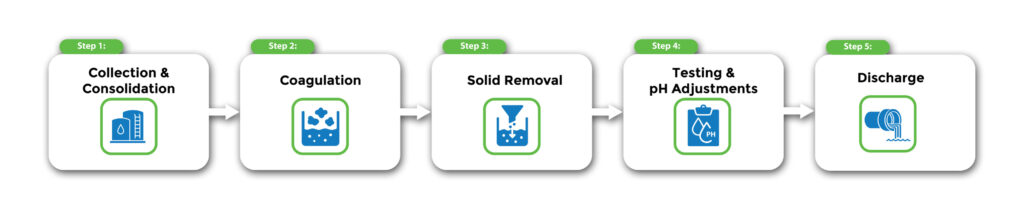
Crystal Clean’s solidification process follows five steps: collection, coagulation, precipitation, testing, and disposal. The approach is built for volume reduction efficiency. Less weight and less volume mean more efficient transportation and broader disposal options.

3. Regulatory Compliance Is Getting Complicated

The regulatory framework for liquid waste is detailed because it poses genuine environmental risks. Storage duration limits restrict how long material can sit before it must be moved; DOT transportation requirements govern containers, labeling, and handling procedures for every mile of transit; and landfill acceptance criteria determine which facilities will take it and in what form. Facilities that have been through an inspection understand how much documentation this generates and how much can go wrong.

Solid waste fits into a simpler framework. The manifest trail shrinks, transportation rules are less specialized, and landfills accepting solidified material have clearer intake procedures.

Crystal Clean conducts solidification in accordance with compliant procedures designed to meet regulatory standards at every stage. Documentation and manifest support come with the service. Your regulatory obligations remain yours, but the paperwork burden shifts and the compliance pathway gets more straightforward.

4. Facility Storage Space is Running Short

Liquid waste consumes more floor space than the drums themselves. Secondary containment takes square footage, spill response clearance takes additional space for safety protocols, and positioning decisions must account for worst-case scenarios.

Then there’s the safety dimension. Liquid waste accumulation creates slip hazards around storage areas. Drum failures or leaks expose workers to materials they shouldn’t come into contact with. Fumes can accumulate in enclosed spaces. The longer liquid waste sits, the more these risks compound. Facility managers who track inventory, manage traffic flow, and plan emergency response all have to work around the liquid waste footprint.

Crystal Clean offers reliable, flexible pickup scheduling for liquid wastes, so waste moves out on a timeline that works for operations rather than racing against storage capacity or containment limits. This helps your facility become cleaner, more organized, and safer to navigate.

5. Sustainability Goals Need Tangible Progress

Customers ask about environmental practices now, and stakeholders measure them. Most operations leaders want to improve when improvement is actually possible.

Solidification moves waste into recovery pathways that liquid waste can’t access. Stable, solid material qualifies for waste-to-energy programs that convert it into usable power rather than burying it. It meets acceptance criteria for properly engineered landfills where containment systems prevent groundwater contamination. The material stays where it’s placed instead of migrating through soil.

Crystal Clean routes over 64 million pounds of waste annually into energy recovery programs. Solidification integrates with other non-hazardous waste disposal pathways too, including recycling and fuel blending for materials that can be reclaimed. Waste that used to be pure cost and liability becomes part of a circular system.

That matters for sustainability reporting. It also matters for the people who have to explain what their facility actually does with its waste. Concrete numbers and documented recovery pathways are easier to stand behind than vague assurances.

Finding the Right Partner

Solidification requires more than equipment. Binding agents have to match waste stream chemistry, the output has to meet actual disposal and landfill requirements, and logistics have to fit operations without creating new coordination problems. Getting any of this wrong means material that doesn’t solidify properly, gets rejected at disposal facilities, or costs more to handle than the liquid form did.

An experienced solidification partner has seen the variations. They know which binding agents work for which waste types, they have the processing capacity to handle volume without bottlenecks, and they maintain the regulatory knowledge to keep documentation clean and disposal pathways open.

Crystal Clean brings solidification capacity, compliance expertise, and the operational flexibility that comes from handling waste streams across thousands of facilities. We build solutions around what you’re actually generating.

Contact Crystal Clean for a free waste assessment. Our team will evaluate your waste streams and recommend the right solidification approach for your operation.

Transform Your Floor Care: Crystal Clean’s Commercial Floor Cleaning Supplies for Efficiency, Savings, and Sustainability

Maintaining clean floors is a universal challenge for businesses. From ensuring safety to enhancing operational efficiency and presenting a professional appearance, clean floors are a cornerstone of any well-maintained facility. However, achieving spotless results often requires significant time and resources, cutting into budgets and productivity.

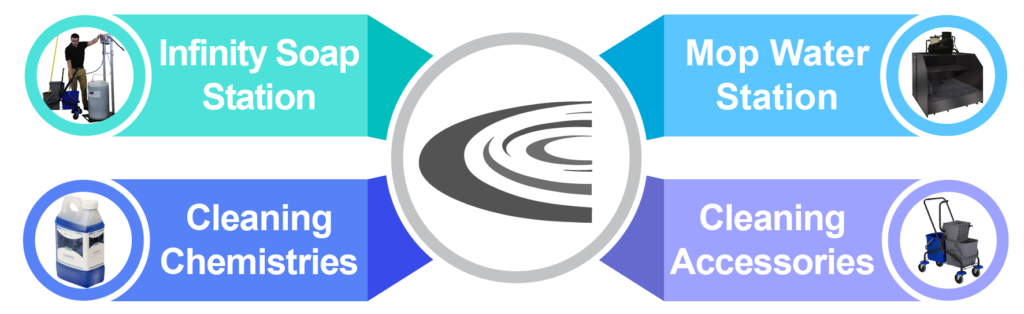
At Crystal Clean, we aim to revolutionize your floor cleaning routine, providing you with cutting-edge floor cleaning solutions to save time, reduce costs, and maximize effectiveness. Our innovative products, such as the Infinity Soap Station, Mop Water Station, and premium cleaning accessories, are designed to make floor cleaning smarter, easier, and more sustainable.

The Infinity Soap Station: Precision Soap Dilution Made Simple

The Infinity Soap Station takes the guesswork out of cleaning solution preparation, ensuring optimal cleaning performance through automatic dilution and precise dispensing of floor cleaning solutions. This innovative system is compatible with Crystal Clean’s specialized industrial floor cleaning solutions, including Beta, Gamma, and Mirachem Floor Cleaner, to deliver exceptional results tailored to various cleaning challenges.

  • Beta Floor Cleaner: A non-corrosive degreaser with a moderate pH, designed for safer, cleaner surfaces and effective rubber mark removal.
  • Gamma Advanced Floor Cleaner: A California-compliant, super-concentrated degreaser for tough, baked-on soils with anti-redeposition properties.
  • Mirachem® Floor Cleaner: A solvent-free, low-foaming formula for routine or heavy-duty cleaning, with extended usability and recyclability.

By leveraging these advanced chemistries with the Infinity Soap Station, businesses can ensure that every drop of cleaner is utilized to its full potential, reducing costs and enhancing efficiency.

This station is not just about cost savings; it’s about consistency. Its precise dilution ratios guarantee the same high-quality cleaning treatment every time, regardless of who is handling the task. This eliminates variability, ensuring a consistently clean and professional environment. Its user-friendly design allows employees to focus on cleaning rather than measuring and mixing solutions.

The Infinity Soap Station also promotes sustainability. By minimizing soap waste and optimizing the use of Crystal Clean’s eco-friendly industrial floor cleaning products, it reduces the environmental footprint of cleaning operations. This aligns seamlessly with modern business values, enabling you to maintain cleanliness without compromising on sustainability.

Mop Water Station: Maximizing Cleaning Power

The Crystal Clean Mop Water Station is a game-changer in floor cleaning efficiency. Traditional methods often require frequent replacement of cleaning solutions, wasting valuable resources. Our Mop Water Station filters out contaminants, allowing you to reuse cleaning solutions while maintaining their cleaning effectiveness. This not only reduces waste but also extends the life of your cleaning products, saving your business money over time.

By keeping the cleaning solution fresh and effective, the Mop Water Station ensures your floors receive the thorough cleaning they need without the hassle of constant solution changes. This innovative approach reduces downtime and allows your team to clean more areas in less time, improving overall productivity.

Additionally, the Mop Water Station contributes to better hygiene standards. By separating contaminants from reusable cleaning solutions, it helps prevent the spread of dirt and bacteria, ensuring a safer environment for employees and customers alike. It’s an efficient, sustainable, and health-conscious solution for businesses of all sizes.

Crystal Clean’s line of cleaning accessories is designed to complement and enhance your floor cleaning routine. Our Double Mop Bucket is a standout accessory, engineered to keep clean and dirty water separate. This simple yet effective design ensures that you’re always mopping with clean water, preventing the reintroduction of grime onto your floors. This results in cleaner surfaces with less effort, boosting both efficiency and cleanliness.

In addition to the Double Mop Bucket, we offer a range of ergonomic tools that make cleaning easier and less strenuous for your staff. From lightweight, adjustable mop handles to specialized scrubbing pads, our accessories are built with user comfort and efficiency in mind. These tools not only speed up the cleaning process but also reduce physical strain on employees, promoting a safer and more productive workplace.

The accessories are also designed to be durable and cost-effective, providing long-lasting performance that saves you money in the long run. When paired with our other solutions, they help create a streamlined, effective cleaning system that meets the highest standards of cleanliness and professionalism.

Choose Crystal Clean for Smarter Floor Maintenance

Clean floors are essential to safety, operational efficiency, and a professional image. With Crystal Clean’s innovative products, including the Infinity Soap Station, Mop Water Station, and premium accessories, you can simplify your floor cleaning routine while reducing costs and waste.

Ready to transform your floor cleaning process? Contact Crystal Clean today to learn how we can help you achieve spotless, efficient, and sustainable cleaning results for your business!

Contact Us

A Guide to Responsible E-Waste Disposal for Businesses in 2026

The Growing E-Waste Challenge

Electronic waste is one of the fastest-growing waste streams businesses face. Computers, monitors, servers, lighting, batteries, and electronic equipment accumulate as technology advances and equipment reaches end of life. The EPA estimates that e-waste represents about 2% of landfill volume but accounts for 70% of the toxic heavy metals in those landfills.

For businesses, e-waste disposal sits at the intersection of environmental responsibility, data security, and regulatory compliance. The equipment retiring from your facility contains valuable materials that can be recovered, hazardous components that require proper handling, and in many cases, data that needs secure destruction before disposal.

Getting e-waste right protects more than the environment. It protects your data, your compliance standing, and your reputation with customers and partners who increasingly expect responsible practices.

What Counts as E-Waste

E-waste covers a broader range of materials than many businesses realize. Understanding what falls into this category helps ensure nothing slips through the cracks.

  • IT equipment: computers, laptops, monitors, servers, keyboards, mice, networking equipment, printers, and peripherals
  • Consumer and office electronics: televisions, audio-visual equipment, smart devices, phones, and tablets
  • Lighting components: fluorescent tubes, compact fluorescent lamps (CFLs), LED bulbs, HID lighting, and ballasts
  • Batteries: lithium-ion, lead-acid, nickel-cadmium, and various rechargeable chemistries, each with different disposal requirements
  • Specialty items: medical devices, laboratory electronics, mercury-containing equipment like thermostats and switches

Many of these items contain hazardous materials: mercury, lead, cadmium, and brominated flame retardants. When e-waste is improperly disposed of, these materials can leach into soil and groundwater. When properly managed, valuable components like precious metals, copper, and plastics can be recovered and recycled.

Why Improper E-Waste Disposal Creates Risk

Disposing of e-waste improperly creates consequences that extend beyond environmental impact.

Environmental concerns are the most visible. Heavy metals and toxic compounds from landfilled electronics can contaminate soil and groundwater over time. Businesses with sustainability commitments or ESG reporting requirements find that responsible e-waste management supports those goals, while improper disposal undermines them.

Data security risks persist in any device with storage or memory. Hard drives, solid-state drives, phones, copiers, and even some printers retain data that can be recovered if not properly destroyed. A retired computer that leaves your facility without secure data destruction creates exposure that no privacy policy can address after the fact.

Compliance obligations vary by jurisdiction, but most states regulate e-waste disposal in some form. Some require recycling of certain electronics. Others classify specific components as universal or hazardous waste with corresponding handling requirements. Multi-state operations face a patchwork of requirements that demand attention.

The businesses that are responsible in how they dispose of their e-waste aren’t necessarily larger or better resourced. They’ve simply built systems that make responsible disposal the default rather than an afterthought.

Steps Businesses Can Take Today

Building an effective e-waste program doesn’t require massive infrastructure. These practical steps create a foundation for responsible disposal.

Conduct an electronics inventory. Before you can manage e-waste effectively, you need visibility into what you have. Walk through your facility and document the electronics in use: IT equipment, lighting, batteries in backup systems, break room appliances. Note approximate ages and replacement timelines. This inventory reveals the scope of your e-waste challenge and helps anticipate future volumes.

Set up a formal collection point. Designate a specific location where retired electronics accumulate before disposal. This prevents e-waste from scattering across storage closets, loading docks, and forgotten corners. A central collection point makes pickup logistics simpler and helps ensure nothing gets accidentally discarded with regular trash.

Create a policy for retiring IT equipment. Document the process for decommissioning computers, servers, and devices. Include steps for data destruction, removal from asset tracking systems, and transfer to the collection point. A written policy ensures consistency regardless of who handles the retirement process.

Educate employees on proper disposal. Staff throughout your facility encounter e-waste: maintenance teams replacing lighting, IT departments cycling out equipment, office managers disposing of batteries. Training ensures everyone knows where e-waste goes and why it matters. Even brief awareness prevents well-meaning employees from putting electronics in the wrong waste stream.

Schedule regular pickups. E-waste that sits too long creates clutter, potential compliance issues, and in the case of batteries, safety concerns. Work with your environmental services provider to establish a pickup schedule that matches your generation patterns, whether that’s monthly, quarterly, or on-demand.

How Crystal Clean Supports E-Waste Disposal

Crystal Clean’s universal and electronic waste disposal service integrates with your broader environmental services program rather than adding another vendor relationship to manage.

We handle the full range of universal and electronic waste businesses generate:

  • Computer and electronic scrap
  • Batteries of all common chemistries
  • Fluorescent, LED, and HID lighting
  • Ballasts and mercury-containing devices

This breadth means one provider covers your e-waste needs. For facilities already working with Crystal Clean for parts cleaning, used oil, or containerized waste, adding e-waste extends an existing relationship rather than creating a new one.

Our service representatives are trained on local, state, and federal regulations governing universal waste. We transport collected materials to recycling facilities where they undergo reclamation processes, recovering valuable components for reuse rather than landfilling them. This supports sustainability reporting while providing the compliance documentation your records require.

Multi-site operations benefit from consistent service across locations. Crystal Clean’s nationwide branch network delivers the same standards whether you’re managing one facility or dozens across different states.

Protecting Your Business and the Environment

E-waste volumes will continue growing as technology cycles accelerate. The question isn’t whether to address e-waste disposal, but whether to handle it systematically or reactively.

Responsible e-waste management protects environmental quality, safeguards data, maintains compliance, and supports the sustainability expectations that customers and stakeholders now treat as baseline requirements. Building it into your environmental services infrastructure makes responsible disposal the path of least resistance.

Partner with Crystal Clean for safe, compliant e-waste disposal tailored to your business needs. Contact our team to discuss how universal and electronic waste management fits within your facility’s environmental program, or request a quote to schedule service.

Choosing the Right Heat Transfer Fluid for Industrial Systems

Industrial facilities rely on heat transfer fluids (HTFs) to manage temperature, protect equipment, and maintain operational continuity across a wide range of environments. Whether supporting HVAC loops, stationary engines, process equipment, or seasonal shutdowns, using the proper fluid is essential for system longevity and performance.

Unlike automotive coolant, industrial HTFs must accommodate diverse operating temperatures, metallurgy, system pressures, and environmental considerations. Additive packages, glycol type, inhibitor chemistries, and OEM requirements all influence which product best fits the application. Selecting the appropriate fluid helps prevent corrosion, scaling, fouling, freeze damage, and costly equipment failures.

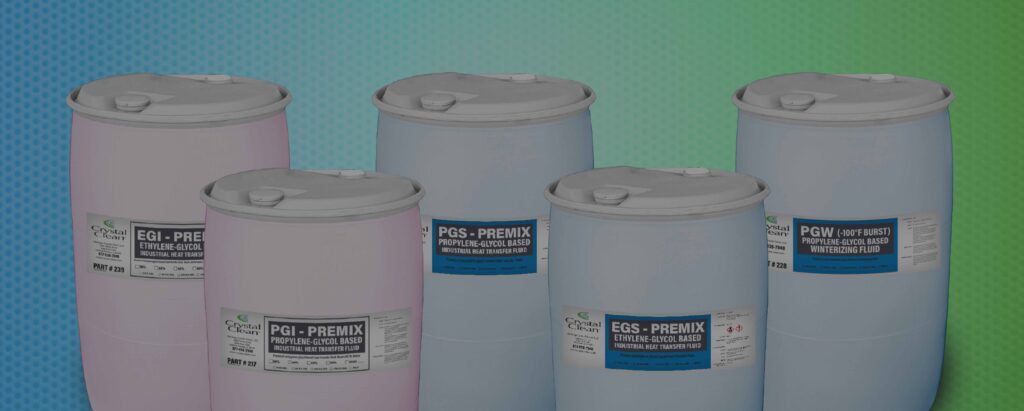
Below is an overview of Crystal Clean’s industrial heat transfer fluid portfolio and where each product delivers its best performance.

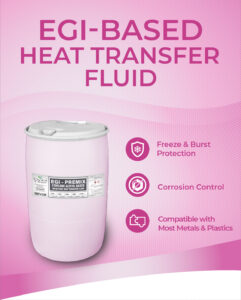
Ethylene Glycol–Based Industrial HTF (EGI-HTF)

Best for: Commercial and industrial systems requiring a high-phosphate, multi-metal corrosion-protected ethylene glycol fluid.

Key Benefits: EGI-HTF uses a robust high-phosphate inhibitor system that provides excellent protection for copper, brass, solder, steel, cast iron, and aluminum. The formulation prevents scaling, fouling, and pH degradation while delivering reliable thermal performance across an operating range of –60°F to +300°F. It is functionally equivalent to DOWTHERM™ and JEFFCOOL® E100, allowing seamless top-offs or changeovers, and is available in both concentrate and ready-to-use premix options for easy implementation.

Where It Fits: Ideal for a wide range of industrial temperature-control applications including HVAC systems, solar heating, process loops, thermal storage, ice rinks, sidewalk melting, floor heating, and cold-room dehumidification.

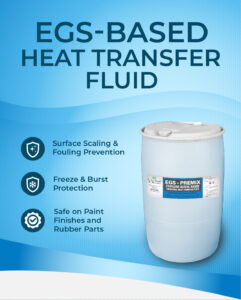
Ethylene Glycol–Based Stationary Engine HTF (EGS)

Best for: Heavy-duty stationary engines requiring nitrited protection and OEM-aligned performance.

Key Benefits: EGS features an advanced inhibitor system with a minimum of 2400 ppm nitrite in concentrate, delivering superior protection against cavitation, hot-surface scaling, and corrosion in wet-sleeve liners, water pumps, and mixed-metal systems. The silicate-free, phosphate-free formulation minimizes deposits while meeting ASTM D6210, D4985, D3306, and D1384 performance standards. It provides year-round defense against freeze-ups, boil-overs, and coolant breakdown, making it a reliable solution for demanding stationary engine environments.

Where It Fits: Designed for oil & gas, natural gas processing, compressor engines, power generation, and other industrial stationary engines. Suitable for use in systems calling for Cummins CES14603, Caterpillar DEAC, John Deere H24, Waukesha 4-1974D, EMD 1748E, and related OEM specifications.

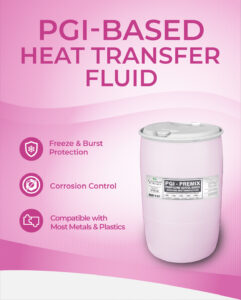
Propylene Glycol–Based Industrial HTF (PGI-HTF)

Best for: Industrial systems needing lower toxicity, high-phosphate inhibitors, and full corrosion protection across wide temperature ranges.

Key Benefits: PGI-HTF combines a propylene glycol base with a high-phosphate, multi-component inhibitor package to deliver excellent corrosion resistance and thermal stability. The reduced toxicity allows for safer handling and disposal, while the formulation protects copper, brass, solder, steel, cast iron, and aluminum from rust, scaling, and acidic attack. With an operating range from –60°F to +300°F and compatibility with DOWFROST HD™ and JEFFCOOL® P150, it provides broad system compatibility and long-term reliability.

Where It Fits: A strong choice for HVAC systems, solar heating, floor heating, thermal storage, ice rinks, sidewalk snow-melting systems, process cooling/heating, and cold-room dehumidification.

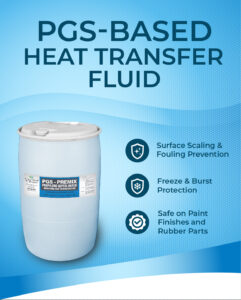
Propylene Glycol–Based Stationary Engine HTF (PGS)

Best for: Stationary engines requiring heavy-duty inhibitors and lower-toxicity glycol bases.

Key Benefits: PGS delivers the same heavy-duty performance expected in stationary engine environments while leveraging a propylene glycol base for reduced toxicity. Its nitrited, silicate-free, and phosphate-free formulation protects wet-sleeve liners from cavitation, shields all system metals from corrosion, prevents hot-surface scaling, and disperses minor oil leakage. Meeting ASTM D6210, D4985, D3306, and D1384 requirements, it maintains dependable freeze, boil-over, and corrosion protection year-round.

Where It Fits: Recommended for oil & gas compression, energy production, natural gas processing, and industrial engine applications requiring OEM standards such as Cummins, Caterpillar, John Deere, Waukesha, and EMD.

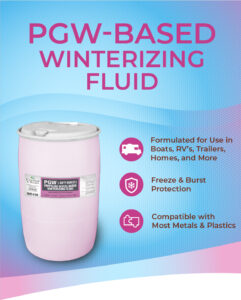
Propylene Glycol–Based Winterizing Fluid (PGW)

Best for: Seasonal shutdowns requiring burst protection for potable water systems, HVAC loops, and recreational equipment.

Key Benefits: PGW is a ready-to-use winterizing solution available in –50°F and –100°F burst protection formulas, using a phosphate-based corrosion inhibitor to protect metals such as copper and brass. Dyed pink or blue for easy system verification, it is safe for most plastics and can be mixed with comparable RV and marine winterizing fluids without adverse effects. Its formulation prevents freeze expansion damage in systems exposed to severe temperatures, providing reliable seasonal protection.

Where It Fits: Ideal for winterizing boats, RVs, trailers, vacation homes, swimming pool filtration systems, and commercial or residential water loops requiring seasonal shutdown.

Matching Products to Industrial Performance and Protection

Choosing the right heat transfer fluid is more than meeting performance specifications—it protects critical equipment, optimizes operational efficiency, prevents unplanned downtime, and simplifies inventory management. Crystal Clean offers an industrial-grade portfolio engineered for superior thermal performance, corrosion resistance, and long-term system reliability.

With high-quality fluids, nationwide supply capability, and closed-loop recycling services for used glycol, Crystal Clean helps industrial operators reduce waste, lower disposal costs, and maintain safe, efficient, and environmentally responsible systems year-round.

Contact Us

The Fundamentals of Industrial Wastewater Management

For today’s industrial and commercial operations, managing wastewater isn’t easy to ignore, it’s an essential part of staying compliant and protecting the environment. When wastewater isn’t handled properly, it can pose serious risks to waterways, communities, and your operation’s regulatory standing. That’s why more businesses are turning to Crystal Clean for dependable, sustainable industrial wastewater management solutions.

With over 100 million gallons of wastewater pre-treated annually, prior to discharge to local Publicly Owned Treatment Works, Crystal Clean helps customers across North America handle their non-hazardous wastewater with confidence. Our full-service approach is built on over 25 years of regulatory expertise, operational efficiency, and environmental responsibility.

Crystal Clean’s Nationwide Wastewater Treatment Solidification Network

Crystal Clean operates a network of advanced wastewater pre-treatment facilities, and solidification facilities for non-treatable solids and sludges, throughout North America. Each wastewater treatment plant is designed to manage a wide variety of non-hazardous liquid and solid waste streams from industrial and commercial operations.

Crystal Clean’s range of customers come from factories and repair shops to chemical plants and commercial buildings. Our facilities use specialized wastewater systems and solidification facilities to treat the waste these operations generate. Each pre-treatment system follows a proven treatment process that removes oils, solids, and other contaminants, ensuring that only clean water is released. If the facilitiy is unable to treat the waste through pre-treatment, we can also alternatively manage the wastes through solidification.

How Our Wastewater Systems Work

Our treatment process follows a structured, five-step method that ensures every gallon is handled with care and precision.

What Happens to the Waste?

Crystal Clean’s industrial wastewater management program includes full accountability for all byproducts:

  • Recovered oils are routed to our in-house used oil re-refinery, where they are transformed into high-quality base oils.
  • Solid materials are stabilized and sent to secure, permitted landfills.
  • Cleaned water is discharged in compliance with EPA, state, and POTW standards.

This integrated model supports sustainability and contributes to a circular economy by recycling valuable materials and reducing waste volume.

Certified Treatment Capabilities

Our wastewater pre-treatment plants are permitted to process a broad range of non-hazardous wastes, including:

  • EPA Subcategory A – Metals
  • EPA Subcategory B – Used Oils
  • EPA Subcategory C – Organics
  • EPA Subcategory D – Mixed Waste
  • Oily Water Treatment
  • Petroleum Phase Separation and Recycling
  • Non-RCRA Liquids & Semi-Solids
  • Non-Hazardous Solidification

Whether you need to treat oily wastewater, organic contaminants, metals, or suspended solids, Crystal Clean has the capacity and certifications to do it right.

Tailored Programs for Compliance and Efficiency

Our team works directly with each customer to design a tailored wastewater management plan that includes:

  • On-site waste stream analysis
  • Scheduled pickups and transportation
  • Full regulatory documentation
  • Ongoing service support and reporting

At Crystal Clean, it is our mission to help you stay compliant, reduce costs, and meet your sustainability goals.

Let’s Work Together to Make the Business World Run Cleaner

Crystal Clean is proud to be a trusted partner in industrial wastewater management, supporting businesses that take their environmental responsibilities seriously. With a reliable network of wastewater treatment plants, expert technicians, and customer-first service, we make it easy to do the right thing for your business and the Earth’s resources.

Contact Us

The Essential Guide to Sustainability and Compliance for Industrial Waste Management

Environmental compliance and sustainability aren’t competing priorities. They’re two sides of the same operational system, and the companies getting this right are building competitive advantages that extend far beyond simply checking the compliance box.

Industrial operations face increasing expectations. Regulators require documented compliance, investors demand measurable ESG performance, customers audit supplier environmental practices, and your workforce expects responsible operations. The businesses succeeding aren’t choosing between these priorities, they’re meeting all of them through integrated waste management systems that strengthen reliability, safety, and sustainability.

Crystal Clean partners with industrial operations to build waste management programs that satisfy both compliance requirements and sustainability objectives. Environmental management is structured properly, the same systems that ensure compliance also advance environmental goals and support safer, more efficient operations.

Understanding the EPA Hazardous Waste Disposal Guidelines

The EPA defines hazardous waste based on specific characteristics: ignitability, corrosivity, reactivity, and toxicity. Identifying which wastes meet these criteria determines the required management approach throughout their lifecycle.

Industrial facilities generate spent solvents from parts cleaning, used oils from equipment maintenance, and chemical byproducts from production. Each waste stream requires specific management protocols, but the regulatory framework remains consistent across industries.

Waste Identification and Classification

The EPA’s hazardous waste lists categorize materials based on their source or properties. F-list and K-list wastes are hazardous because of how they’re generated. P-list and U-list wastes are specific chemical formulations. Characteristic wastes become hazardous when they exhibit certain properties through testing or generator knowledge.

Accurate classification determines your regulatory obligations. A metal fabricator generating spent cutting fluids needs different procedures than an automotive shop managing used oil. Both require proper characterization, but the specific requirements vary based on waste types and generation volumes. This is why standardized procedures supported from a reliable service partner matters.

Your generator status—determined by monthly waste volumes—establishes which regulations apply. Very Small Quantity Generators (100 kg or less monthly) have streamlined requirements. Small Quantity Generators (100-1,000 kg monthly) face moderate obligations. Large Quantity Generators (1,000+ kg monthly) must meet comprehensive standards, including 90-day storage limits, detailed emergency procedures, and regular reporting.

Waste management partners like Crystal Clean help facilities maintain generator status compliance with consistent scheduling, documentation support, and proper waste classification.

Storage, Labeling, and Containment

Proper storage prevents incidents and protects employees, facilities, and the environment while maintaining compliance. Containers must be compatible with waste contents, certain solvents degrade plastic, some acids corrode metal. Each container needs clear labeling showing “Hazardous Waste,” the accumulation start date, and contents description.

Accumulation time limits create planning requirements. Large quantity generators have 90 days. Small quantity generators have 180 days (or 270 days if shipping more than 200 miles). Exceeding these limits triggers different regulatory classifications with significantly more requirements.

Secondary containment systems provide backup protection if containers leak. Spill pallets, bermed areas, or containment structures must hold at least 10% of the total stored volume or the largest container’s volume, whichever is greater. This prevents waste from reaching soil or stormwater systems if primary containment fails.

Incompatible wastes require separation. Acids can’t be stored with bases. Oxidizers need isolation from organic materials. Proper segregation prevents reactions that could create safety hazards or compromise waste characterization.

Transportation and Disposal

Transportation requires manifest documentation that creates a paper trail from generation through final disposal. You originate the manifest with generator information, transporter details, designated facility information, and complete waste descriptions, including EPA codes and quantities.

Each party in the transportation chain signs the manifest, transferring custody at every handoff. The disposal facility returns the completed manifest confirming proper receipt. This documentation proves waste reached authorized facilities and was managed according to regulations, becoming a critical piece of tracking your compliance.

Federal law requires manifest retention for three years. Many states require longer periods. Electronic manifest systems streamline this recordkeeping while improving accuracy and retrieval capabilities.

Final disposal methods vary by waste characteristics. Some materials can be recycled or re-refined. Others require incineration or specialized treatment. Modern facilities can neutralize acids, recover valuable components from spent materials, and destroy persistent compounds through advanced treatment technologies.

Recordkeeping and Documentation

Beyond manifests, you must maintain waste characterization records showing classification decisions, inspection logs documenting storage area reviews, and training records proving personnel have received required instruction. Large Quantity Generators submit biennial reports summarizing waste generation and management methods.

These records serve compliance verification during inspections and provide data for sustainability reporting. Systematic documentation processes generate required records as part of normal operations rather than creating separate compliance exercises.

used oil disposal

Top Sustainability Practices for Industrial Businesses

Sustainability practices that reduce environmental impact often strengthen compliance posture while improving operational efficiency. The following approaches create measurable benefits across multiple objectives.

1. Waste Minimization

Reducing waste generation eliminates disposal costs, decreases raw material consumption, and may lower your generator status classification. Process optimization often reveals significant opportunities. A metal fabricator modifying cutting patterns might reduce scrap by 15%. A printing operation switching ink formulations could cut spent solvent volumes by 30%.

Inventory management affects waste generation. Chemicals expiring before use become disposal problems. Raw materials degrading in storage must be discarded. Just-in-time inventory practices for materials with limited shelf life reduce waste while improving cash management.

Material substitution can eliminate hazardous waste streams entirely. Switching from solvent-based to aqueous cleaning removes hazardous spent solvents from your waste streams. Using alternative process chemicals may render the generated waste non-hazardous. Each substitution that eliminates hazardous waste removes associated compliance obligations and contributes to stronger sustainability reporting metrics.

2. Recycling and Reuse

Many waste streams traditionally sent to disposal can be recycled or reclaimed. Used oil can be re-refined into base oils that meet virgin product specifications, while producing 77% fewer greenhouse gas emissions than virgin production. Spent solvents can be distilled and reused. Used Antifreeze can be recovered for reuse.

The regulatory framework supports legitimate recycling. Materials genuinely being recycled often qualify for streamlined requirements compared to waste destined for disposal. However, recycling claims must be substantiated. Materials must actually be recovered and reused, not merely declared recyclable while going to landfills.

Closed-loop systems represent the most sophisticated recycling approach. Solvent recovery equipment distills spent solvent on-site and returns recovered material to production. Water treatment systems enable process water reuse. These systems eliminate disposal while reducing raw material purchases.

From a sustainability perspective, recycling demonstrates resource efficiency. From a compliance perspective, reducing hazardous waste generation may lower your generator status and associated regulatory requirements.

3. Energy Recovery Programs

When waste can’t be eliminated or recycled, energy recovery provides environmental benefits beyond landfilling. Certain waste streams with sufficient heating value can fuel industrial processes at facilities specifically permitted for this purpose.

This approach prevents materials from being sent to landfills while reducing fossil fuel consumption. Cement kilns, industrial boilers, and other permitted facilities can utilize appropriate waste streams as alternative fuels. The waste must meet compositional requirements and heating value standards, and receiving facilities must properly manage combustion residues.

Energy recovery isn’t appropriate for all wastes, but for streams with suitable characteristics, it provides measurable environmental benefits while maintaining regulatory compliance.

4. Water Conservation

Industrial water consumption creates both cost and environmental impact. Closed-loop water systems recirculate process water rather than discharging after single use. Treatment components remove contaminants so water meets process specifications for reuse.

This reduces freshwater consumption and the volume of wastewater discharged. Since wastewater management costs often depend on volume, conservation delivers direct economic benefits alongside environmental improvements and may simplify discharge-related compliance obligations.

Process modifications can dramatically reduce water needs. Equipment upgrades may achieve better results with less water. Operational changes might enable water reuse between process steps. Counter-current rinsing systems can reduce rinse water consumption by 90% compared to conventional methods.

From a sustainability reporting perspective, water reduction metrics demonstrate resource efficiency. From a compliance perspective, lower discharge volumes may reduce permitting requirements and monitoring obligations while supporting broader sustainability goals.

5. Sustainable Partnerships

Your waste management partners either support or undermine your sustainability objectives. Selecting partners who prioritize environmental performance helps you achieve goals extending beyond facility boundaries.

Evaluate potential partners on treatment methods and resource recovery capabilities. Do they actively pursue recycling options or default to disposal? Do they operate recovery facilities or only landfills? Can they provide data about the environmental benefits of their approaches?

Partner sustainability practices appear in your Scope 3 emissions calculations. The treatment methods they use directly affect your reported environmental footprint. Partners with lower-impact methods improve your sustainability metrics without requiring operational changes.

Geographic proximity reduces transportation emissions associated with waste management. When choosing between similar providers, closer facilities reduce your carbon footprint from logistics.

How Crystal Clean Supports Sustainable Compliance

Navigating the intersection of compliance and sustainability requires expertise many facilities don’t maintain in-house. Crystal Clean approaches waste management as an integrated system serving both regulatory requirements and environmental objectives.

Our service model addresses the complete waste lifecycle while creating documentation needed for compliance verification and sustainability reporting. The foundation starts with proper waste characterization, compliant storage and labeling, authorized transportation, and permitted treatment or disposal. This is all supported by trained sales and service representatives committed to safety and environmental stewardship.

Beyond baseline compliance, we optimize treatment methods for environmental performance. When waste can be recycled, we direct it to recovery facilities. When re-refining is possible, we process materials into reusable products. When advanced treatment technologies can destroy persistent compounds, we utilize facilities with those capabilities to ensure waste is managed in the most sustainable, compliant manner available.

Our nationwide network with local presence creates consistency across multi-site operations while adapting to state-specific requirements. Your procedures remain uniform, but implementation accounts for regional regulatory differences and local operational needs.

Our customer portal provides waste stream reporting that analyzes your wastes and tracks specific impacts on your carbon footprint. This data supports both compliance documentation and sustainability reporting requirements. Electronic systems track waste from pickup through final disposition, providing the records needed for audits and stakeholder reporting.

Because we operate our own permitted treatment, recovery, and recycling facilities, we provide more options than transportation-only vendors. This means greater flexibility in matching waste streams to optimal management methods, recycling when possible, advanced treatment when necessary, and disposal only when other options aren’t viable.

Our environmental specialists evaluate your facilities for waste minimization opportunities and process improvements. We monitor regulatory changes at state and federal levels, keeping you informed of upcoming changes that may impact your operations. This expertise supplements your internal capabilities without requiring you to maintain specialized knowledge across all environmental regulations and promoted proactive compliance.

Make Compliance Part of Your Sustainability Strategy

Environmental compliance and sustainability represent aligned outcomes from the same operational practices. When you implement waste minimization, you simultaneously reduce disposal costs, lower environmental impact, and potentially decrease regulatory obligations. When you select partners with resource recovery capabilities, you ensure compliance while improving emissions metrics that investors scrutinize.

Building this integrated approach requires treating waste management as strategic infrastructure. Select partners based on capabilities and expertise, not just price. Document practices to satisfy both regulatory agencies and sustainability auditors. View environmental performance as a competitive advantage rather than a cost of doing business.

The businesses succeeding at this integration recognize that operational decisions affect both compliance posture and sustainability performance. They’ve built systems that work consistently, selected partners whose capabilities match their needs, and treated environmental management as a strategic function.

Your waste management program deserves the same strategic attention you give other operational functions. The right approach, implemented consistently across your organization, becomes a strategic asset that protects operations, satisfies stakeholders, and advances environmental objectives while simplifying regulatory compliance.

Stay compliant, sustainable, and ahead of regulations. Partner with Crystal Clean today to build a customized waste management program that aligns with your environmental goals, strengthens operational performance, and supports a cleaner future.

Aqueous Vs Solvent Chemistries: Which is Best for You?

When it comes to parts cleaning, not all chemistries are created equal—and the choice between aqueous and solvent-based cleaners can significantly impact your facility’s performance, safety, and compliance. Whether you’re running an automotive shop, manufacturing line, or industrial maintenance operation, understanding the strengths and regulatory considerations of each option is key to choosing the best fit for your operation.

So how do you decide? Let’s break it down.

Aqueous Chemistries: Safe, Sustainable, and Compliance-Friendly

Aqueous cleaners are water-based solutions formulated with detergents and other non-hazardous ingredients. They’re known for being:

  • Safer for workers – Non-flammable and low toxicity
  • Easier to manage – Often don’t count toward hazardous waste generator status
  • Environmentally responsible – Lower VOCs and reduced regulatory risk
  • Effective for general-purpose cleaning – Especially when combined with heat and agitation
Compliance Advantages

Federal and state regulations make aqueous chemistries especially attractive. Because many aqueous solutions are non-hazardous, used fluid may not require hazardous waste disposal, helping you maintain a lower EPA generator status. That means fewer regulations, lower disposal costs, and simplified recordkeeping.

Aqueous chemistries also typically have lower VOC content, making them a good fit for facilities operating in regions with strict air quality standards, such as California or New York.

Solvent Chemistries: High-Powered Performance with a Compliance Tradeoff

Solvent-based cleaners are hydrocarbon or chlorinated solutions that offer superior degreasing power, making them the go-to choice for:

  • Removing heavy oils, tars, and carbon
  • Precision cleaning on metal parts
  • Applications where quick drying is needed
  • Cleaning where water could cause corrosion or residue
Compliance Considerations

The downside? Many solvents are classified as hazardous waste after use. This affects your EPA generator status, triggers RCRA regulations, and may increase your disposal and reporting requirements. You’ll also need to follow OSHA standards for flammable materials and local air permits if VOC levels are high.

That said, if your facility is equipped to manage these requirements and needs top-tier cleaning strength, solvents still play a valuable role.

Choosing What’s Right for You

The best chemistry depends on your operational priorities:

  • If your goal is to reduce waste, lower generator status, and stay ahead of regulations, aqueous solutions are likely your best bet.
  • If your operation demands maximum cleaning power for high-contamination parts, solvent-based products may be worth the added compliance effort.

Many facilities benefit from a hybrid approach—using aqueous chemistries for general cleaning and solvents for targeted, heavy-duty jobs. Crystal Clean can help assess your needs and recommend the right mix of products and services for your operation.

Crystal Clean Can Help You Make the Switch

Whether you’re considering a switch to aqueous chemistries or looking to optimize your solvent program, Crystal Clean has the expertise, service, and product line to support your goals. We offer:

  • Safer, high-performance aqueous solutions
  • Non-chlorinated solvents with improved regulatory profiles
  • Waste pickup, documentation, and disposal support
  • Guidance on maintaining or lowering your EPA generator status

Let’s work together to create a cleaning program that fits your facility—and your compliance strategy.

Contact Us

Why is it Regulated: APHIS Waste

Not all regulated waste is the same. What sets APHIS waste apart is its origin. Any waste that has traveled to or originated outside of the United States and Canada within the past two years is considered APHIS waste.

The reason for this classification is straightforward but critical. Foreign food products and packaging materials can carry pests, plant diseases, or contaminants that pose risks to U.S. agriculture, ecosystems, and even public health. To prevent these threats, the USDA Animal and Plant Health Inspection Service (APHIS) has strict rules for how this waste must be handled and disposed of.

What Can Be Considered APHIS Waste?

When most people hear “regulated waste,” they think of hazardous chemicals or medical byproducts. APHIS waste is different because it often looks ordinary which is why it is important to bring attention to what it is. Any item that came into contact with imported food or beverages may be classified as APHIS waste.

This includes:
  • Packaging materials like wrappers, cartons, and cans.
  • Utensils, napkins, and disposable tableware that touched foreign food.
  • Containers or bottles that once held beverages.

A key point to remember: once this material is mixed with regular trash, the entire batch becomes contaminated and must be treated as APHIS waste. This makes careful segregation essential in airports, shipping facilities, and businesses that handle imported products.

How APHIS Waste Must be Managed

Unlike ordinary garbage, APHIS waste cannot simply be placed in a dumpster and hauled away. Regulations require that it be collected and managed by trained professionals to ensure safety and compliance.

The standards include:
  • Tight, covered, and leak-proof containers to prevent leakage or accidental exposure.
  • Clearly marked receptacles labeled as regulated waste to avoid confusion with other trash streams.
  • Final treatment by incineration or sterilization, ensuring that any potential pests, diseases, or contaminants are destroyed before disposal.

These requirements are not optional and are mandatory steps designed to protect agriculture and prevent the accidental introduction of invasive species or pathogens.

Why Professional Disposal Matters

Failing to comply with APHIS regulations can result in severe consequences, including fines, legal penalties, and environmental damage. Businesses that manage imported goods such as airlines, shipping companies, and logistics providers are especially at risk if proper waste practices are not followed.

By working with a trusted waste management provider, organizations gain:

  • Peace of mind, knowing their operations meet government requirements.
  • Regulatory compliance with USDA APHIS standards.
  • Secure, reliable collection and disposal using approved methods.
  • Reduced liability risks, protecting both brand reputation and the environment.

The Crystal Clean Advantage

At Crystal Clean, we provide a full-service solution for APHIS waste. From supplying compliant containers to transporting waste securely and ensuring final treatment by incineration or sterilization, our trained teams handle every step.

We know that compliance is more than a box to check, it’s about safeguarding agriculture, trade, and communities. By choosing Crystal Clean, businesses gain a partner that combines regulatory expertise with dependable service, helping them focus on operations while staying fully compliant.

Protect your business and community. Trust Crystal Clean for your regulated waste needs.

Contact Us