Managing Antifreeze Waste Across Multiple Service Bays: A Practical Guide

A shop with four bays collects more spent antifreeze in a month than a single-bay operation runs does in a quarter. However, the collection setup is often the same whether it’s four bays or one. A drum near the back of the service area, a pickup schedule somebody set years ago, and instructions that mostly live in the head of whoever’s been there longest. 

Across multiple bays and multiple shifts, small handling oversights compound. A container fills up faster than the pickup schedule anticipated, drain locations doesn’t quite line up with where the container sits. None of these are serious individually, but together they produce rejected pickups that turn into compliance exposure that occurs during an inspection rather than before an inspection.

This guide covers what those oversights look like in practice, the impacts on your disposal process, and how to address them at the operational level so they stop being recurring problems.

What Spent Antifreeze Is After It Leaves the Engine

The fluid that drains out of an engine’s cooling system looks similar to what went in. That visual similarity is part of why spent antifreeze so often gets handled as if it’s the same product, just used when it isn’t.

Over the service life of a coolant charge, the corrosion inhibitors that kept the cooling system protected get consumed. The fluid picks up what it’s been circulating through the engine, which means heavy metals accumulate from normal cooling system wear, including copper and zinc from radiator cores and thermostats, and iron from engine blocks and water pump housings. The pH drifts as the corrosion inhibitors deplete, and depending on how long the coolant ran past its service interval, it can drift far enough to start eating at the engine it was protecting.

Heavy metal concentration matters too. Spent antifreeze can fail the Toxicity Characteristic Leaching Procedure for lead in some cases, depending on the source vehicles and how long the coolant was in service. The classification isn’t determined by the label or the fluid type, it’s determined by what’s in the drum, which means testing is the only way to know with confidence.

This means operationally that the disposal available to you is set before the fluid reaches the container. A shop servicing older vehicles or fleet trucks with extended drain intervals has a different spent antifreeze problem than a quick-lube operation handling routine flushes on late-model passenger vehicles. The collection system has to account for the real generation profile, not an assumed one.

The Mixing Problem and What It Costs Your Operations

Co-mingling is the most common and most expensive issue in multi-bay antifreeze handling. A drum of spent antifreeze that is clean has recovery value, while a drum of antifreeze contaminated with used oil, solvent, or brake fluid has no recovery value, only disposal cost.

The conditions that produce co-mingling are structural. Containers fill faster than scheduled pickups can accommodate, so something has to happen with the next gallon that comes out. Drain pans are used across multiple fluid types over a shift, and floor drains in shared service areas catch whatever runs off, so what comes out of one bay can end up in the same collection point as what comes out of another. Shift changes interrupt what goes into which container is for what. None of these are technician failures, they’re the consequence of a collection system that was never designed for the throughput the shop is running.

What happens when contamination reaches the drum determines what happens when the drum reaches the receiving facility. A small amount of contaminant drives spent antifreeze toward different processing pathways and alters the disposal cost structure. Solvent contamination can impact this significantly, because petroleum solvents lower the flash point of the mixture and can push the load into hazardous classification depending on concentration. Chlorinated solvent contamination is the one that really matters. Even trace amounts of chlorinated material disqualify a load from glycol recovery entirely, because the chlorine compounds spoil the recovery process and contaminate the recycled product. A single contaminated drum can compromise an entire pickup.

The drum that came out of bay three on a busy Friday isn’t going to notice it picked up half a quart of brake cleaner. The receiving facility will.

Receiving facilities test on arrival. The screening is fast, covering pH, flash point, halogen presence, glycol concentration, and visual inspection for separation or unusual color. A load that looks suspect on arrival gets sampled thoroughly, and the results determine whether it goes through recovery, gets repriced as disposal, or gets rejected and sent back. Rejection is the worst outcome because the drum still has to go somewhere, the original transportation cost is a sunk loss, and the next destination is almost always disposal at hazardous rates.

One rejected load can easily impact your operations. You account for the failed pickup, the disposal repricing, and the labor around all of it. A shop running multiple service bays will typically pay less than that annually for a properly designed collection program with scheduled pickups and the documentation infrastructure that prevents contamination in the first place.

Regulatory Obligations at Multi-Bay Volume

The obligations that grow with throughput are the ones that surprise multi-bay operators most often. A one-bay shop handling a few drums of spent antifreeze a year operates under one set of practical rules, while the same handling approach in a six-bay operation generating substantially more volume operates under a different set, even when the workflow looks similar.

Spent antifreeze that tests as non-hazardous falls under state regulations and varies by jurisdiction. Spent antifreeze that tests as hazardous falls under RCRA Subtitle C, your generator status, whether Very Small Quantity Generator, Small Quantity Generator, or Large Quantity Generator. These determine storage time limits, accumulation quantity caps, training requirements, contingency planning, and reporting obligations. The thresholds are based on monthly generation totals across all hazardous waste streams, not just antifreeze, so a shop generating modest amounts of hazardous antifreeze along with hazardous parts-cleaning solvent and hazardous brake fluid can cross into a higher generator status without realizing it, and the regulations change accordingly.

Container requirements grow with volume too. A 55-gallon drum sitting against a wall with a handwritten label works in a low-volume context, but at higher throughput, you need containers in defined accumulation areas. These need to be properly labeled with accumulation start dates, kept closed except when adding waste, inspected weekly with documented inspections, and managed within the storage time limits your generator status allows. The shop running identical practices at a higher volume isn’t doing anything different. But what’s around them changed, and the regulation changes that causes  tend to go unnoticed until something forces the issue.

How Spent Antifreeze Gets Tested, Classified, and Routed

When a load arrives at a processing facility, incoming testing determines what happens next. The results route the load to one of three pathways: recovery, treatment for disposal, or rejection.

Recovery requires the spent antifreeze to meet specific glycol concentration thresholds, generally above a minimum that makes the recovery viable. Below that threshold, the material can’t be processed into recycled antifreeze and routes to disposal regardless of how clean it is. This is why dilution is its own problem, because antifreeze diluted with rinse water or floor washdown water can’t be recovered.

The recovery process is straightforward. Glycol gets separated from water and contaminants through distillation, then the recovered glycol is tested for purity and refortified with new corrosion inhibitor. The result is recycled antifreeze that meets performance requirements of ASTM D3306 and depending on formulation, ASTM D6210. Shops purchasing recovered antifreeze are getting products tested against the same performance standards as virgin coolant, manufactured from material they generated themselves through closed-loop recovery.

Loads that route to disposal cost more for several reasons. Treatment is more involved, the processing facility carries the long-term liability rather than placing the material back into productive use, and the regulatory framework around hazardous disposal carries documentation and tracking requirements that recovery doesn’t. The price difference between a recovery-eligible load and a disposal-bound load is significant, and over the course of a year, it’s often the largest variable in a shop’s antifreeze program cost.

Building a Collection System That Works With Growth

Most multi-bay shops have a container, but they don’t have a system. The difference shows up in everything that happens around the container: where it sits, how it gets filled, who tracks it, what happens when it’s full, and what documentation follows it out the door.

Container placement should match workflows. A container located near the most frequently used drain points reduces the number of transfers between drain pans and final storage, and transfers are where contamination tends to enter the stream. The container should be positioned with appropriate secondary containment, away from incompatible waste streams, and visible enough that inspection isn’t an exercise in looking for it.

Labeling and documentation also have to survive shift changes. Accumulation start dates need to be marked when the container starts filling, not when someone remembers to check. Inspection logs need to be kept where they get filled out rather than where they get stored, and manifests, bills of lading, and pickup records need to live in a system that the next shift can find without asking the previous shift. None of this requires sophisticated infrastructure, but it does require that the infrastructure exists, and in a lot of multi-bay shops it doesn’t, or it exists in someone’s brain and walks out the door at the end of their shift.

Pickup frequency should be calibrated to actual generation volume rather than to a default schedule that may have made sense at a different throughput level. A shop generating substantially more spent antifreeze than its pickup schedule accommodates ends up with overflow, improvised storage, and the conditions that produce contamination. A shop on an over-frequent schedule pays for unnecessary service. The right cadence sits between those extremes and shifts as the operation changes.

Your Antifreeze Partner

The problems in a multi-bay antifreeze program tend to be operational rather than technical. The chemistry isn’t complicated, and the regulations aren’t unknowable. What gets shops in trouble is a collection system that was sized for an earlier version of the shop and never updated as throughput grew, combined with documentation infrastructure that depends on individual memory rather than having a process.

A program built around the actual volume and workflow of the facility addresses most of these issues before they become compliance issues. Containers end up in the right places, pickup schedules match generation, and material gets routed to recovery wherever the chemistry allows.

The shops that fix this don’t usually fix it because something dramatic happened. They fixed it because somebody finally looked at the problem with fresh eyes and realized the version they were running was three operational changes behind where the business actually was.

Crystal Clean’s antifreeze program is built around the operational realities this section describes. Pickups get calibrated to actual volume, containers get placed for the workflow you have rather than the workflow somebody assumed. To assess your current antifreeze program and set up scheduled service calibrated to your operation, contact Crystal Clean.

Common Mistakes That Can Change Your Generator Status

Hazardous waste is part of the job for a lot of operations. But what catches people off guard is how fast your generator status can change if things aren’t managed closely.

Whether you’re a VSQG or SQG, that status drives how you handle, store, and track your waste. And it doesn’t take a major issue to move into a higher category. A few small missteps can bring tighter rules, more paperwork, and higher costs.

Letting Waste Build Up

This is one of the biggest ones. When hazardous waste drums sit too long or volumes creep up, it’s easy to cross thresholds without realizing it. By the time it’s noticed, you’re already over. Staying on a steady pickup schedule keeps waste moving and helps avoid those surprises.

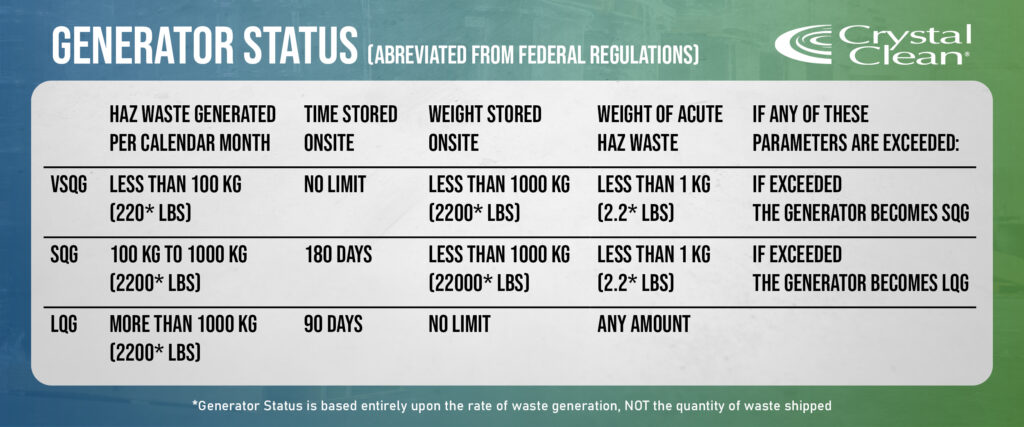
Refer to the image below to see a quick guide to what the thresholds are for VSQG, SQG, and LQG status.

Misidentifying Waste Streams

Not everything belongs in the same drum. Each waste stream is unique and should be properly identified before disposal. Mixing non-hazardous and hazardous waste can unnecessarily increase the amount hazardous waste, resulting in higher disposal costs and additional compliance requirements. Even small mistakes can disrupt reporting, create compliance challenges, and lead to avoidable expenses.

It also creates problems when it’s time for pickup or inspection. Knowing exactly what you’re generating and where it goes keeps things clean and straightforward.

Poor Storage Practices

Open containers, missing labels, or storing waste in the wrong area will get attention quickly during an inspection. It’s not just about appearance. These issues raise safety concerns and can lead to violations on the spot. Keeping storage areas tight and organized goes a long way.

Inconsistent Pickup Schedules

Waiting until containers are full or space is tight usually leads to rushed calls and short-term fixes. That’s when mistakes happen. Regular, planned service keeps levels under control and takes the pressure off your team.

Lack of Internal Awareness

A lot of problems start with simple miscommunication. One shift does things one way, another does it differently, and before long things are off track. Making sure everyone understands the basics of handling and storage helps prevent small issues from turning into bigger ones.

Stay Ahead of It

Generator status isn’t something you want to deal with after the fact. Once you’ve crossed a line, fixing it takes time and effort. Staying ahead of it comes down to consistency and having the right support. Crystal Clean works with customers in the field every day to keep waste streams organized, pickups on schedule, and operations running the way they should.

With the right setup in place, it’s a lot easier to stay compliant without slowing things down.

Contact Us

Crystal Clean Earns Union Pacific 2025 Chemical Transportation Safety Pinnacle Award

Crystal Clean is proud to announce it has received Union Pacific’s 2025 Chemical Transportation Safety Pinnacle Award—marking the third time the company has earned this prestigious recognition.

Presented to organizations that demonstrate exceptional performance in the safe transportation of regulated materials, the Pinnacle Award reinforces Crystal Clean’s role as a trusted partner in delivering compliant, reliable environmental services.

Union Pacific, a key rail partner, supports Crystal Clean in transporting materials such as base oil, used oil, solvents, and other regulated waste streams. In 2025, Crystal Clean completed more than 650 rail shipments in partnership with Union Pacific, achieving zero non-accident releases (NARs)—a significant milestone that reflects the company’s unwavering commitment to safety and operational excellence.

Crystal Clean manages hundreds of millions of gallons of waste annually, with transportation playing a critical role in moving materials safely for consolidation, treatment, and recycling. This achievement highlights the strength of Crystal Clean’s transportation program, supported by rigorous processes such as railcar operations training, detailed inspection protocols, and securement procedures.

In addition, Crystal Clean maintains a strong focus on continuous improvement through corrective action programs, including root cause investigations and compliance accountability measures.

Crystal Clean’s success is driven by collaboration across its nationwide network, including branch operations, sales and service teams, transportation professionals, and rail logistics specialists.

Contact Us

Better Cleaning Starts with the Right Chemistry and the Right Approach

Cleaning parts are part of the daily routine in any shop, but it can also be a constant frustration. When parts don’t come out clean the first time, technicians end up redoing the work. That slows everything down and cuts into productivity.

A lot of the time, the problem isn’t the machine. It comes down to the cleaning solution being used and how it’s applied.

Different Soils Need Different Solutions

Not everything you’re cleaning is the same. Shops deal with grease, oil, carbon buildup, dirt, rust, paint, adhesives, and coatings on a regular basis.

Each of these behaves differently. A cleaner that works well on oil might not do much against rust or baked-on coatings. When one product is expected to handle everything, results can be hit or miss, and rework becomes part of the routine.

Getting the Chemistry Right

Using the right cleaning solution makes a big difference. Products like Mirachem are designed to break down specific types of soils more effectively than general-purpose cleaners.

When the chemistry matches the job, parts come out cleaner the first time. That means fewer repeat cycles, less labor, and a process that runs more smoothly.

How It’s Used Matters

The way the solution is used is just as important as the solution itself. Things like dilution, temperature, dwell time, and whether you’re using a spray or immersion system all affect the outcome.

When those details are dialed in, the cleaning process becomes more consistent and efficient. It also helps get more life out of the solution and the equipment.

More Than Just Cleaner Parts

When everything is working the way it should, the benefits go beyond appearance. Shops see less downtime, fewer slowdowns, and a more efficient workflow overall.

There are safety and environmental benefits as well. Modern aqueous solutions are easier to handle and reduce the need for harsher solvents, helping create a safer work environment and support more responsible waste handling.

Why Experience Makes a Difference

Figuring out the right combination of solution and process can take time if you’re doing it on your own. Trial and error usually leads to wasted effort and inconsistent results.

That’s where Crystal Clean comes in. Our team works with customers to understand what they’re cleaning, how they’re cleaning it, and what challenges they’re running into. From there, we help match the right chemistry, like Mirachem, with the right setup to get better results.

A Smarter Way to Clean

Better cleaning doesn’t happen by accident. It comes from using the right solution and applying it the right way.

With the right setup, shops can cut down on rework, keep things moving, and get consistent results day in and day out.

Contact Us

Spill Response and Prevention: What OSHA and EPA Standards Require

Most facilities have a spill response plan. A binder near the loading dock, a procedure in the employee handbook, maybe a laminated sheet posted by the drum storage area. What most facilities don’t have is a program that holds up when a spill happens and regulators start asking questions.

That gap is often where compliance risk and potential enforcement actions come from.

Two Frameworks, One Compliance Obligation

Spill response compliance isn’t governed by a single standard. Two federal frameworks apply simultaneously, and satisfying one without fully accounting for the other is where most facilities quietly accumulate exposure they don’t know about.

OSHA’s HAZWOPER standard (29 CFR 1910.120) governs how people respond when something goes wrong. It governs how personnel respond to hazardous substance releases, including emergency response operations at facilities not traditionally considered treatment or disposal sites. The standard defines training tiers, competency requirements, and equipment specifications that determine who is legally permitted to respond and under what conditions.

EPA’s SPCC rule (40 CFR Part 112) governs oil spill prevention at facilities storing oil above certain thresholds with potential to discharge to navigable waters. Facilities storing more than 1,320 gallons of oil in aboveground containers typically need a written SPCC plan that meets specific engineering and operational requirements.

The overlap between the two is where facilities most commonly fall short. A solid SPCC plan doesn’t satisfy HAZWOPER training obligations. HAZWOPER compliance doesn’t substitute for SPCC’s engineering controls. State-level rules add another layer on top of both, often with shorter notification windows and stricter containment thresholds than the federal floor.

Facilities that consistently perform well during inspections aren’t the ones who got lucky on timing. They’re the ones who understood from the start that they were managing two compliance obligations, not one.

Prevention Is Infrastructure, Not Paperwork

Effective spill prevention protects not only regulatory compliance, but also employee safety, operational continuity, and the surrounding environment. Before regulators evaluate how a facility responded to a spill, they evaluate whether it prevented the spill from occurring. Prevention gaps are the first findings in a post-incident investigation, and they compound whatever followed.

Secondary containment is the foundation. Storage areas for hazardous materials require containment systems designed to hold the volume of the largest container plus appropriate freeboard, in accordance with applicable regulations. Tanks, drums, day tanks, and transfer areas each carry their own requirements based on volume, material type, and proximity to drainage. Knowing which standard applies to each configuration is the work that prevention requires.

Inspection and maintenance obligations don’t stop after initial setup. Containers, tanks, valves, and transfer equipment must be inspected on defined intervals with documentation to match. Without documentation, even properly maintained equipment may be considered non-compliant.

Spill kits need to be right for the job and positioned where the job actually happens. A compliant kit includes absorbent materials rated for the specific substances in that area, appropriate PPE for the associated hazard profile, containment barriers, and disposal bags for contaminated materials. Contents matter, but location matters just as much. A kit stored in a back room for safekeeping rather than staged near the most likely release points satisfies the appearance of compliance, not the requirement. Kits also need to be inspected and restocked after every use.

HAZWOPER training connects prevention to response. Facilities where employees may respond to hazardous substance releases must provide tiered training: first responder awareness, first responder operations, hazardous materials technician, and incident commander. Each level has defined hour minimums and competency demonstrations, and all of it requires documentation that holds up when an inspector reads it looking for compliance.

Closing these gaps requires more than a written plan. It requires the right combination of training, infrastructure, and ongoing operational support.

When a Spill Happens, Classification Comes First

When a release occurs, the first priority is determining whether it is an incidental release or one that requires an emergency response under OSHA definitions.

An incidental release can be contained and cleaned up by employees in the immediate work area without evacuation or significant exposure risk. Employees with appropriate training can handle these using standard facility procedures.

Emergency releases involve situations that exceed the facility’s ability to safely control the hazard. Any spill requiring evacuation, presenting inhalation or exposure hazard, or exceeding the capacity of standard procedures crosses into HAZWOPER emergency response territory. At that point the response has a defined structure: a designated incident commander, personnel in appropriate PPE for the specific hazard, and trained technicians managing containment and source control. This isn’t a team assembled on the fly when a problem surfaces. It’s a structure that exists before anything goes wrong, with roles assigned, people trained, and equipment staged.

Sending an untrained employee into what turns out to be an emergency release is a separate regulatory violation, independent of the underlying incident.

Immediate obligations include notification, containment, and documentation, in that order, starting at the moment of discovery. Certain releases require immediate notification to the National Response Center (NRC), as well as applicable state and local agencies. Missing a notification deadline is its own violation. The documentation record begins when the release is discovered, not after cleanup is complete.

When internal response capacity runs out, the obligation is straightforward: stop internal activities and bring in qualified outside contractors. Continuing improvised response past the point where internal capability ends compounds liability with every additional step taken without proper authorization.

Having the Right Partner Before You Need One

The facilities that get through spill incidents without significant regulatory consequence made a decision before anything happened. They treated preparedness as an operational requirement, not a response to the last close call.

That means the right prevention infrastructure is in place before it’s needed. Spill kits stocked and positioned for the actual hazard profile of the facility. Containment that meets the applicable regulatory requirements. Documentation that can be produced quickly when someone asks for it.

It also means a response partner identified and ready before the 2 a.m. call has to be made.

Crystal Clean helps facilities move beyond basic compliance by aligning prevention, preparedness, and response into a single, integrated program. From properly specified spill kits and containment solutions to on-site assessments and 24/7 emergency response, our teams help ensure your operation is prepared before an incident occurs. With a nationwide network of trained professionals, regulatory expertise, and end-to-end documentation support, Crystal Clean serves as a single, accountable partner across your environmental needs.

Prevention and response under one partner means no gap between the vendor who supplied containment products and the contractor who shows up for emergency response. No inconsistency in the documentation trail. No coordination problem at the worst possible moment.

Contact Crystal Clean to assess your current spill preparedness and identify gaps before they become findings.

waste drum disposal

Hazardous vs Non-Hazardous Waste: Classification Guide for Businesses

You know that drum in your maintenance bay? The one with spent solvent from parts cleaning that’s been sitting there since the machine shop retrofit? Someone labeled it, and you’re reasonably sure the label is accurate. You’re less sure what “accurate” means when the EPA has 600+ waste codes, and your current vendor has never asked for a sample.

Classification is where compliance either works or falls apart. Get it right, and the waste moves through the system, the documentation holds up, the auditor nods and moves on. Get it wrong, and you discover the problem at the worst possible moment: an inspection, a spill, or a manifest that doesn’t match what the receiving facility received.

Who This Guide Is For

This piece is written for manufacturing operations managers and facility directors who generate multiple waste streams and manage environmental compliance as one of many responsibilities. You’re not an environmental specialist. You have EHS obligations alongside production targets, maintenance schedules, and vendor coordination that already consumes more bandwidth than it should.

If you’re running a small auto shop with one parts washer and a used oil tank, the classification basics here apply, but the complexity we’re addressing probably exceeds your situation. That’s fine. You need a reliable partner, not a regulatory deep-dive.

If you’re a corporate EHS director managing environmental programs across fifty facilities, you already know the material in this guide. What you need is execution consistency across sites, which is a different conversation.

This is for the operations professional in the middle: sophisticated enough to know classification matters, busy enough to want someone else handling the details, accountable enough to need confidence that it’s being done right.

Understanding Hazardous Waste

The EPA defines hazardous waste through two pathways: characteristics and listings. Both create obligations. Both create liability. The distinction matters because characteristic waste requires testing, while listed waste carries its designation regardless of what a test might show.

The Four Characteristics

Waste exhibits hazardous characteristics when it demonstrates specific properties. The tests exist. The question is whether anyone is running them on your waste streams.

Ignitability (D001). Liquids with a flash point below 140°F. Solids that ignite through friction or moisture absorption. Compressed gases. Oxidizers. The test is straightforward, but “straightforward” doesn’t mean it’s happening. When your spent solvent fails an ignitability test that your vendor never ran, you discover you’ve been storing hazardous waste under a non-hazardous label. That discovery rarely happens at a convenient time.

Corrosivity (D002). Aqueous materials with pH at or below 2.0, or at or above 12.5. Materials that corrode steel at specified rates. Battery acid. Caustic cleaners. Metal finishing solutions. The pH strips are cheap. The question is whether anyone’s using them before the drum gets labeled.

Reactivity (D003). Unstable materials. Anything that reacts violently with water or releases toxic gases when mixed with water or acid. Cyanide or sulfide-bearing wastes that generate toxic fumes under certain pH conditions. These require careful handling because the hazard emerges from interaction. A drum that’s stable in your accumulation area becomes dangerous when it meets incompatible waste at a facility that didn’t know what it was receiving.

Toxicity (D004-D043). The Toxicity Characteristic Leaching Procedure simulates what happens when waste sits in a landfill, and rain percolates through it. If contaminants leach out above regulatory thresholds, the waste is toxic. Heavy metals. Certain pesticides. Specific organic compounds. The TCLP covers 40 contaminants with individual thresholds.

Here’s what the regulations don’t tell you: TCLP testing costs money, takes time, and many vendors skip it when they can plausibly assume non-hazardous. That assumption becomes your liability when the receiving facility runs their own tests and the results don’t match the manifest.

Crystal Clean’s staff doesn’t assume. Classification across 600+ EPA waste codes means knowing which tests to run, running them, and documenting results that hold up when someone else checks the work. The vendor who shows up with a drum and a label is doing something different than the partner who shows up with a sample kit and a question.

Listed Wastes

Beyond characteristics, the EPA maintains four lists of wastes deemed hazardous regardless of test results:

F-list covers non-specific source wastes from common industrial processes. Spent halogenated solvents (F001-F002). Non-halogenated solvents (F003-F005). Metal finishing sludges. Degreasing operations. If your manufacturing floor uses chlorinated solvents for parts cleaning, you’re generating F-list waste whether or not anyone’s tracking it that way.

K-list covers source-specific wastes from particular industries. Petroleum refining. Wood preserving. Pesticide manufacturing. The codes are narrow, but if your operation falls into one of these categories, you have specific designations that apply regardless of what the waste actually contains.

P-list and U-list cover commercial chemical products discarded unused or off-specification. P-list chemicals are acutely hazardous. U-list chemicals are toxic. The distinction that catches operations managers: a bottle of solvent used for cleaning generates spent solvent waste. The same solvent discarded unused becomes a listed waste with different handling requirements. Same chemical. Different regulatory pathway. Different cost.

Generator Status: Where Classification Meets Operations

The classification of your waste streams determines your generator status. Large Quantity Generators, Small Quantity Generators, and Very Small Quantity Generators face different regulatory requirements: Storage time limits, accumulation quantity limits, training requirements, emergency planning, and reporting obligations.

Lower generator status means less regulatory burden, potentially lower insurance premiums, and less inspector attention.

The operations managers who’ve optimized this understand that proper classification isn’t about finding the most restrictive category to be safe. It’s about finding the accurate category to be legal and efficient. Over-classifying costs money in disposal premiums. Under-classifying creates violation exposure that dwarfs any savings. The accurate classification—verified, documented, defensible—is the one that optimizes both.

That requires someone who actually knows the 600+ EPA waste codes and runs the appropriate tests. Not someone who makes assumptions because testing takes time.

What is Non-Hazardous Waste?

Just because waste doesn’t meet hazardous criteria doesn’t mean it goes in a dumpster. Non-hazardous industrial waste still requires proper management through appropriate disposal pathways. The regulations are less prescriptive, but the liability doesn’t disappear.

Categories of Non-Hazardous Industrial Waste

Spent industrial fluids: Used coolants and cutting fluids from machining operations, floor scrubber wastewater, aqueous parts washer chemistry, or antifreeze. These require proper disposal but don’t trigger hazardous requirements—assuming no contamination changed the classification along the way.

Solid industrial waste: Oil-absorbent materials from routine maintenance (when the absorbed material isn’t hazardous), used filters that have been properly drained, or packaging contaminated with non-hazardous substances to name a few.

Wastewater and sludges: Oily water from separators (when oil content and characteristics stay below hazardous thresholds), settling tank sludge, or process wastewater that meets discharge or non-hazardous disposal criteria.

The operational trap: non-hazardous classification assumes the waste stream stays consistent. Machine coolant that’s non-hazardous in normal use becomes something else when your maintenance team dumps contaminated solvent into the same tank. Nobody tested it. Nobody documented the change. The manifest says non-hazardous. The receiving facility’s analysis says otherwise.

Universal Waste: The Middle Ground

Universal waste rules create streamlined management for certain common hazardous wastes that pose lower risks during collection and transport. Batteries. Fluorescent lamps. Mercury-containing equipment. Electronics. Pesticides.

The category exists because standard hazardous waste rules would be impractical for materials that nearly every business generates. Longer accumulation times. Simplified labeling. Reduced recordkeeping.

But universal waste still requires proper handling through authorized channels. The simplification is in the accumulation rules, not the disposal requirements.

Recovery Changes the Economics

Some waste streams contain value that recovery operations can extract. Used oil goes to re-refineries and comes back as base oil. Spent antifreeze gets processed and returns to OEM quality. Solvents go through distillation and re-enter service.

Crystal Clean’s Indianapolis re-refinery processes used oil into Group II base oils meeting API and ILSAC standards. The process—vacuum distillation, hydrotreatment, steam stripping—produces base oil with 77% lower greenhouse gas emissions than virgin production.

That number matters when the sustainability questionnaire arrives. Corporate wants environmental metrics. Customers want supply chain documentation. The board wants ESG performance data. You can report an estimate based on assumptions about what probably happened to your waste, or you can report a verified figure from a partner who owns the processing and documents the outcome. One of those answers invites follow-up questions. The other closes the file.

Collection connects to processing connects to the return of refined product to market. That’s a different model than a broker who arranges pickup and sends your oil somewhere you’ve never verified. The operations manager who understands cradle-to-grave liability appreciates the difference. Your name stays on that waste until it reaches final disposition. Knowing where “final disposition” actually happens matters.

Key Differences: Quick Reference

FactorHazardous WasteNon-Hazardous Waste
Regulatory FrameworkRCRA Subtitle C, state hazmat regulationsRCRA Subtitle D, state solid waste rules
Generator StatusVSQG, SQG, LQG with escalating requirementsNo generator status categories
Storage LimitsTime limits based on generator status (90-270 days)Varies by state; generally more flexible
Container RequirementsDOT-approved, specific labeling, closed except when adding/removing wasteLess prescriptive; good management practices
ManifestingUniform Hazardous Waste Manifest requiredBill of lading typically sufficient
Disposal FacilitiesPermitted TSDFsPermitted industrial landfills, treatment facilities
Disposal CostHigher due to treatment requirements and liabilityLower but not trivial for industrial waste

Cost Implications

Treatment complexity, regulatory burden, and long-term liability all factor into hazardous disposal costs. A drum of hazardous solvent costs substantially more to dispose than a drum of non-hazardous wastewater.

The comparison gets complicated when classification goes wrong. Over-classify and you’re paying hazardous rates for material that didn’t require them. Multiply that by the drums you generate monthly, and the annual cost of classification errors adds up. Under-classify and the violation exposure dwarfs whatever you saved.

Recovery changes the math entirely. Used oil that meets specifications for re-refining costs less to manage than oil contaminated with solvents that disqualify it. The difference between “used oil” and “contaminated oil” is often what your team mixed into the collection tank when they thought no one was watching. Segregation discipline pays for itself.

Environmental Impact Beyond Compliance

Proper classification opens pathways that turn waste liability into environmental performance. Hazardous waste routed to energy recovery displaces virgin fuel. Used oil processed through re-refining produces base oil with documented environmental benefits. Materials recovered from universal waste re-enter manufacturing supply chains.

These outcomes only happen when waste gets classified correctly and routed to facilities with recovery capabilities. A broker who doesn’t own processing facilities doesn’t have the same incentive to route your waste to recovery. Their economics work whether your oil gets re-refined or burned.

Crystal Clean owns the processing. That alignment matters when your ESG reporting requires verified environmental metrics, not estimates.

Common Waste Streams in Manufacturing

Solvents

Degreasing operations. Parts cleaning. Surface preparation. The solvents that make manufacturing work become the waste streams that create classification complexity.

Halogenated solvents—chlorinated compounds like trichloroethylene, methylene chloride, perchloroethylene—carry F001-F002 waste codes with specific disposal requirements. Non-halogenated solvents fall under F003-F005 with different treatment standards. The chemistry you chose for operational reasons creates regulatory consequences you may not have considered.

F-list waste triggers accumulation time limits. Manifest requirements. Higher disposal costs. Generator status implications. The regulatory burden compounds with every drum, and for many manufacturing operations, the parts cleaning solvent is the single largest driver of hazardous waste volume.

Which raises a question the operations manager eventually asks: does parts cleaning actually require hazardous solvent?

Aqueous parts cleaning systems eliminate halogenated solvent waste streams entirely. No F-list waste generated. No accumulation time limits. No hazardous manifest requirements. Crystal Clean’s aqueous parts washers use chemistry that breaks down grease and oil without creating hazardous waste. The cleaning gets done. The regulatory burden disappears. The generator status calculation changes.

Oils and Lubricants

Machine oils. Hydraulic fluids. Cutting fluids. Every manufacturing operation generates used oil, and the classification determines disposal economics.

Used oil meeting certain specifications qualifies for re-refining. Contaminated oil—mixed with hazardous solvents, containing excessive chlorine or heavy metals—requires different handling at higher cost. The specifications are technical. The consequences are financial.

Crystal Clean’s collection connects directly to the Indianapolis re-refinery: 75 million gallon annual capacity, 24/7 operations, laboratory testing that verifies what actually arrives. The closed loop from your facility to re-refined base oil is documented and verifiable. When your sustainability reporting asks where your used oil went, you have an answer that holds up to scrutiny.

Coolants and Metalworking Fluids

Metalworking fluids break down over time. Bacteria growth. Tramp oil contamination. pH drift. The fluid that was non-hazardous when you put it in the sump may not be non-hazardous when you pull it out.

Water-soluble coolants may be treatable as wastewater if contamination levels stay low. Straight oils follow used oil pathways if uncontaminated. The “if” in both sentences is where classification errors live.

The sump gets pumped on a Tuesday. The manifest says non-hazardous. Three weeks later, the receiving facility’s analysis flags contamination that changes the classification. Now you’re explaining to an inspector why your documentation doesn’t match their records, and the conversation isn’t about the coolant anymore—it’s about your entire waste program.

Process Chemicals

Acids. Bases. Plating solutions. Etching chemicals. The materials that enable your manufacturing process become waste streams with specific regulatory requirements.

Spent pickle liquor from steel processing has its own waste code. Caustic cleaning solutions may trigger corrosivity thresholds. Electroplating solutions carry listed designations regardless of test results.

Classification depends on concentration, contamination, and process origin. A vendor who asks questions before pickup is protecting both of you. A vendor who assumes the label is accurate is creating exposure you’ll discover at an inconvenient moment.

Documentation That Survives Audits

Manifests

Every drum of hazardous waste that leaves your facility needs a paper trail. Generator signs. Transporter signs. Receiving facility signs. Each copy returns to complete the chain of custody.

A manifest that never comes back is a compliance gap requiring investigation and potential regulatory notification. The burden falls on you, the generator, to ensure the receiving facility confirms receipt.

Crystal Clean maintains manifest records accessible through an online portal. When an auditor asks for documentation from eight months ago, it’s retrievable in minutes. The operations managers who’ve scrambled through filing cabinets during an inspection understand what that’s worth.

Storage and Labeling

Hazardous waste accumulation areas have configuration requirements. Containers closed except when adding or removing waste. Labels showing contents and accumulation start date. Aisles for inspection and emergency access. Secondary containment for liquids.

Non-hazardous industrial waste has more flexibility, but careless storage invites problems and inspector attention.

Crystal Clean provides guidance on accumulation area setup and container labeling. An accumulation area that passes inspection without findings is the goal. The time to discover labeling problems is before the inspector arrives, not during the walkthrough.

Training Records

RCRA requires hazardous waste training for personnel who handle waste. Emergency procedures. Proper handling. Contingency plans. Annual refresher training.

Documentation matters as much as the training itself. An inspector will ask to see records. The training that happened but wasn’t documented might as well not have happened.

The Classification Question You Should Be Asking

The operations manager who reads this far already knows something isn’t quite right with their current waste program. Maybe it’s the vendor who’s never asked for samples. Maybe it’s the accumulation area that hasn’t been audited internally in two years. Maybe it’s the used oil tank that’s been receiving “whatever needs to go” since before the current maintenance supervisor started.

The question isn’t whether proper classification costs more than what you’re doing now. The question is whether what you’re doing now is actually legal, or whether you’re operating on assumptions that haven’t been tested.

The waste streams you’re not sure about? Those are the ones worth examining first.

Find out what’s costing you. Request a waste stream assessment and get clarity on classification, disposal pathways, and recovery opportunities you may be missing.

Contact Us

Sustainability You Can See: What Happens When Waste Is Managed the Right Way

Sustainability gets talked about a lot, but for most facilities, it’s not about buzzwords or big promises. It’s about what’s actually happening on the floor every day. Is the shop clean? Are storage containers staying in good shape? Are spills getting handled before they turn into problems?

When waste is managed the right way, sustainability isn’t hard to spot. You can see it in safer work areas, smoother operations, and fewer headaches tied to spills or compliance issues.

It Starts Where the Work Gets Done

Good waste management starts at the source. That means proper containers, spill prevention, and routine service that keeps things from backing up or getting out of control.

When a facility has the right setup in place, environmental protection becomes part of the normal workday. Facilities stay cleaner and workers aren’t scrambling to deal with messes that could have been prevented.

Consistent Service Is What Makes It Work

Having the right equipment helps, but consistency is what really makes the difference. Waste needs to be picked up on time and handled the right way, every time.

That’s where service shows its value.

With Crystal Clean’s scheduled waste collection services, materials like used oil, oily wastewater, antifreeze, solvents, and other regulated wastes are removed before containers overfill or create risk. Service representatives follow compliance requirements with each visit, making sure waste is handled properly and documentation is complete and readily available.

Over time, that consistency adds up to fewer emergency cleanups and less stress for the people responsible for the site.

Knowing Where Your Waste Goes Matters

Another sign that waste is being managed the right way is knowing what happens after it leaves your facility.

Crystal Clean provides clear documentation for every service visit, helping customers stay organized and confident when it comes to compliance. Waste is transported and processed through permitted facilities based on its specific type, so there’s no guesswork about where materials end up or how they’re handled.

That kind of visibility makes sustainability real. You’re not just hoping things are being handled correctly. You know they are.

Turning Waste Into Something Useful Again

One of the most visible examples of sustainability is what happens next.

Many of the materials Crystal Clean collects are treated, recycled, or reprocessed rather than simply disposed of. Used oil can be re-refined into high-quality base oils and other usable products. Other waste streams are managed through approved treatment and recycling processes that reduce environmental impact and protect natural resources.

For facility managers, that means waste is no longer just something to get rid of. It becomes part of a smarter system that keeps operations running cleanly and responsibly without adding extra work on site.

What It Looks Like Day to Day

When waste is managed the right way, the difference is noticeable.

Facilities stay cleaner
Spills and leaks are less likely
Safety improves for employees
Paperwork and compliance feel more manageable

These results don’t come from big changes or complicated programs. They come from steady, reliable service and people who know what they’re doing.

Sustainability That Shows Up on the Floor

Real sustainability isn’t something you read about in a report. You see it in how a facility runs and how confident the team feels managing it.

When waste is handled with care, experience, and consistency, sustainability becomes part of the job, not another thing to worry about.

Because doing things the right way should make work easier, not harder.

Contact Us

Food & Beverage Manufacturing Wastewater Treatment Solutions

Food and beverage manufacturing generates wastewater that may push past what municipal systems are designed to treat without pretreatment support. The volumes are high and the organic loads are intense, with pH swinging wildly depending on what’s being processed and whether sanitation is mid-cycle. The regulatory framework requires navigating multiple overlapping authorities simultaneously: FDA requirements, EPA pretreatment standards, and local sewer district limits that vary by jurisdiction and rarely agree with each other.

Getting wastewater treatment wrong creates problems that cascade: discharge violations, sewer surcharges eating into margins, and production slowdowns that ripple through the schedule. Facilities that run smoothly have learned to manage their wastewater as a core operational function, not an afterthought, because proper treatment protects both the operation and the environment it’s part of.

Understanding Food & Beverage Wastewater

Municipal treatment plants are designed around domestic sewage as their baseline. What comes out of a food processing facility carries significantly higher organic loads, wider pH variability, and more unpredictable flow patterns than that baseline accounts for.

Processing operations generate the bulk of it: washing raw materials, cooking, cooling, and packaging. These all produce water heavy with organic matter and the composition shifts based on what’s running through the line that day. Cleaning and sanitation add another layer: CIP (clean-in-place) systems, floor washing, and equipment sanitization contribute significant volumes with variable chemical composition, including the caustic and acidic agents that make pH so unpredictable. Cooling systems bring their own contribution, potentially picking up lubricants and other contaminants from the processing equipment they serve.

What makes food and beverage wastewater distinctive is how these characteristics combine. Biochemical oxygen demand (BOD) and chemical oxygen demand (COD) run extremely high compared to municipal wastewater. Organic solids create loading issues that accumulate over time and pH can fluctuate from acidic to alkaline shift as products move through the line and cleaning chemicals cycle through the system.

Volume compounds the challenge when peak flows during washdowns and shift changes can overwhelm systems sized for average conditions. A facility might discharge relatively little during production hours and then release a surge when sanitation crews come through. Any treatment program built around averages can fail at the moments that matter most.

Regulatory Requirements for Food & Beverage Facilities

There are two sets of rules, often different in their specifics, and businesses are responsible to make sure they meet them. That’s the regulatory reality for food and beverage facilities managing wastewater discharge.

Federal pretreatment standards from the EPA establish baseline requirements for what can be discharged into publicly owned treatment works (POTWs). These standards exist because industrial-strength discharge at the concentrations food processing generates can overwhelm municipal treatment processes without intervention. High BOD loads can overload biological treatment, solids can accumulate in sewer lines and pH extremes damage infrastructure and kill the microorganisms that make treatment work.

Local sewer districts typically impose limits stricter than the federal floor, with BOD caps in the form of total suspended solids (TSS) limits. Discharge permits that specify monitoring requirements, sampling frequencies, and reporting obligations are needed for local sewer districts. The specifics depend entirely on your local authority, which means a facility in one jurisdiction can face different limits than an identical operation twenty miles away.

The penalties for non-compliance go beyond fines. Repeated violations can trigger increased monitoring requirements, mandatory pretreatment system installation, or revocation of the discharge permit entirely. Some facilities have faced production shutdowns when their discharge problems became severe enough to threaten the POTW’s own compliance.

Crystal Clean works within this regulatory framework with documentation and reporting support built into the service relationship. When discharge characteristics shift because of a new product line, seasonal production changes, or tightening local limits, having a partner who understands both the technical treatment side and the regulatory reporting side turns those adjustments into operational transitions, avoiding compliance crises.

Treatment Solutions for Common Challenges

What works for one waste stream won’t always work for another. The treatment approach has to address each challenge on its own terms while accounting for how they interact in your facility.

High-Strength Organic Waste

The BOD and COD levels in food processing wastewater routinely exceed what sewer districts will accept without pretreatment or surcharges. A dairy operation or brewery can easily generate wastewater with BOD levels 10 to 20 times higher than domestic sewage. At those concentrations, discharging without pretreatment risks overwhelming your local POTW’s biological processes and triggering surcharges or violations.

Reducing organic loading requires either on-site pretreatment or removal of high-strength waste streams before they enter the sewer system. There are several options, such as biological treatment that uses microorganisms to break down organic matter or chemical treatments which can precipitate solids and reduce loading. The right approach depends on your waste characteristics, volumes, and local discharge limits.

Crystal Clean has a wastewater management program which can remove high-strength liquid waste streams via vacuum truck for off-site treatment at Crystal Clean’s own permitted treatment facilities. This reduces the organic load in your discharge and shifts the treatment burden to facilities specifically designed and permitted to handle it.

pH Control and Neutralization

Food processing involves acids and bases that create pH swings in wastewater throughout the day. Things like, citric acid from fruit processing, caustic cleaners from CIP systems, the discharge might be acidic one hour and alkaline the next, depending on where you are in the production and sanitation cycle.

Sewer systems cap pH for good reason. Extreme levels damage pipes, disrupt treatment biology, and can release toxic gases in confined spaces. Facilities need either equalization basins to blend flows and moderate pH, or active neutralization systems that adjust pH before discharge.

For batches of strongly acidic or alkaline wastewater that can’t be safely neutralized and discharged on-site, Crystal Clean’s vacuum truck services remove them for proper treatment at permitted facilities, keeping your discharge within limits without the risk and complexity of attempting on-site neutralization.

Solids Separation and Sludge Removal

Removal options include screens, settling tanks, and clarifiers to capture organic solids before they reach the sewer system. These systems work continuously until the solids accumulate to the point where they need removal, and they lose effectiveness gradually enough that the decline isn’t always obvious until discharge numbers start climbing.

The material that accumulates is typically a liquid or semi-solid slurry rather than dry solids. Crystal Clean’s vacuum trucks handle these applications. We remove accumulated sludge from settling tanks and clarifiers, transporting it for proper treatment, and restoring the system to full capacity. This applies to liquid and sludge waste streams; food solids that are managed separately require containerized disposal.

Every food and beverage operation is different. What a beverage producer generates looks nothing like what comes out of a meat processing line. Seasonal operations create spikes and lulls that year-round facilities never see. Crystal Clean builds custom treatment programs around each facility’s reality rather than applying a template that fits no one well.

Facility Storage Space is Running Short

Liquid waste consumes more floor space than the drums themselves. Secondary containment takes square footage, spill response clearance takes additional space for safety protocols, and positioning decisions must account for worst-case scenarios.

Then there’s the safety dimension. Liquid waste accumulation creates slip hazards around storage areas, drum failures or leaks expose workers to materials they shouldn’t come into contact with, or fumes can accumulate in enclosed spaces. The longer liquid waste sits, the more these risks compound. Facility managers who track inventory, manage traffic flow, and plan emergency response all have to work around the liquid waste footprint.

Crystal Clean offers reliable, flexible pickup scheduling for liquid wastes, so waste moves out on a timeline that works for operations rather than racing against storage capacity or containment limits. This helps your facility become cleaner, more organized, and safer to navigate.

Choosing the Right Treatment Partner

Call a general waste services company about food processing wastewater, and you might come away with more questions than answers. The contaminants are different, the regulatory framework involves food safety considerations alongside environmental compliance. Production schedules and sanitation requirements create operational rhythms that differ significantly from standard industrial facilities.

Industry expertise matters here. A partner who understands the connection between your sanitation schedule and your wastewater profile can anticipate problems a generalist might miss. That understanding comes from working inside food and beverage operations, not from reading about them.

24/7 availability isn’t optional. When your separator backs up or your settling tank overloads, sanitation stops. When sanitation stops, production stops. Response time in food and beverage processing carries a cost that it simply doesn’t in a facility running one shift with no food safety obligations.

Fleet capabilities need to match the work. Routine separator maintenance needs a smaller vacuum truck unit. Tank cleanouts and sludge removal need more capacity. A provider handling food and beverage facilities needs both, plus the flexibility to handle scheduled service and emergency calls with the same level of expertise.

Where does the waste go? Crystal Clean operates its own regional wastewater treatment facilities designed to treat industrial waste streams. Discharge from these facilities meets EPA, state, and POTW standards. Manifests, service records, and treatment verification create the chain of custody that proves proper handling when auditors or regulators come through.

Partner With Crystal Clean

Between organic loading, pH volatility, solids accumulation, and discharge limits that vary by jurisdiction, food and beverage facilities carry a wastewater burden that most industries never have to think about. Managing all of it simultaneously while keeping production moving is the job.

Crystal Clean handles vacuum services, treatment at our own permitted facilities, and compliance documentation under one program. Scheduled service prevents problems. Emergency response addresses them when prevention falls short. And complete documentation means you’re ready when auditors arrive, not scrambling to reconstruct a paper trail.

Your operation deserves a partner who doesn’t need the twenty-minute explanation.

Contact Crystal Clean for a free waste assessment. Our team will evaluate your waste streams and recommend the right solidification approach for your operation.

Crystal Clean Re-Refined Products

At Crystal Clean, sustainability and innovation work hand in hand. Our state-of-the-art oil re-refinery in Indianapolis, Indiana, is permitted to process up to 75 million gallons of used oil each year, transforming it into high-performance fuels and base oils that support a wide range of industries.

From lubricant blenders and asphalt producers to industrial manufacturers, Crystal Clean’s re-refined products deliver the performance, reliability, and consistency our customers depend on while supporting a cleaner and more sustainable future.

LDF – Light Distillate Fuel

Light Distillate Fuel (LDF) is a clean-burning fuel used across industrial and manufacturing applications. As a recycled, renewable product, LDF provides dependable energy output while helping customers reduce their reliance on virgin petroleum.

By capturing value from used oil, Crystal Clean’s LDF turns a potential waste stream into a practical, sustainable energy resource.

VTAE – Vacuum Tower Asphalt Extender

Vacuum Tower Asphalt Extender (VTAE) is a heavy, viscous product used in asphalt blending and road construction. It enhances pavement flexibility, durability, and performance, making it a preferred choice for asphalt manufacturers seeking a reliable, cost-effective solution.

VTAE replaces traditional virgin asphalt extenders with a re-refined alternative that lowers environmental impact without compromising quality to support a more sustainable infrastructure.

HTLF – Hydrotreated Low Flash Fuel

In Crystal Clean’s Hydrotreater Unit (HT), Hydrotreated Low Flash Fuel (HTLF) is produced as part of the re-refining process that upgrades Vacuum Gas Oil (VGO). This light, refined fuel is highly flammable and offers clean combustion with minimal odor, making it well-suited for industrial heating and blending applications.

HTLF delivers consistent performance while helping businesses minimize emissions and meet modern efficiency standards.

HTLS – Hydrotreated Low Sulfur Fuel

Hydrotreated Low Sulfur Fuel (HTLS) is anothe25198r fuel product from the Hydrotreater that meets stringent environmental requirements. With a significantly reduced sulfur content, HTLS provides an environmentally responsible option for commercial and industrial use.

Its stability and cleanliness make it ideal for customers seeking a balance between performance and compliance with clean fuel standards.

HCC 80 – Group II Base Oil

Crystal Clean’s HCC 80 Group II Base Oil is a mid-viscosity, high-purity base oil designed for use in a wide range of lubricants — from industrial fluids to automotive and marine formulations. It offers excellent oxidation stability, low volatility, and superior cleanliness, ensuring long-term performance and reliability.

With its consistent properties and compatibility with major additive systems, HCC 80 helps lubricant blenders create finished products that meet demanding operational standards.

HCC 150 – Group II Base Oil

Our flagship HCC 150 Group II Base Oil delivers the highest quality and consistency, exceeding major industry standards — including API SP, ILSAC GF-6, and API CK-4/SM when blended with additives from leading suppliers.

Beyond performance, HCC 150 represents a significant environmental advantage. A third-party verified study by ClimeCo found that Crystal Clean’s HCC 150 re-refined base oil has a 77% lower greenhouse gas footprint compared to virgin base oil. By choosing HCC 150, customers gain a proven, sustainable alternative that performs to the highest specifications while supporting carbon reduction goals.

Quality, Performance, and Responsibility in Every Product

Every Crystal Clean product undergoes rigorous laboratory testing to ensure it meets or exceeds industry specifications. Our focus on quality, reliability, and customer satisfaction means every gallon we produce supports the highest standards of performance and environmental stewardship.

From fuels that power industry to base oils that drive efficiency and sustainability, Crystal Clean’s re-refined products are transforming how businesses think about resource recovery.

Learn more about how Crystal Clean’s re-refined products can support your blending, manufacturing, and sustainability goals and join us in advancing a cleaner, smarter future.

Contact Us

5 Signs Your Business Needs Professional Non-Hazardous Waste Solidification Services

Managing non-hazardous liquid waste creates operational challenges that many facilities don’t realize they can solve until they explore solidification services. Here’s a simple way to understand the difference between solid and liquid waste: solid waste goes in a garbage bag, while liquid waste requires containment.

That distinction sounds basic, but it shapes everything about how waste gets handled on the ground. Solid waste sits where you put it, while liquid waste needs secondary containment, specialized containers, spill protocols, and contingency planning for when containment fails. Two completely different operational realities.

Solidification bridges them. The process converts liquid and semi-solid waste into solid form through binding agents. What comes out is stable, transportable, and qualifies for disposal options that liquid waste can’t touch. Waste that requires containment now goes in a bag. For operations struggling with liquid waste logistics, compliance headaches, or rising disposal costs, that transformation changes the math on waste management entirely.

Here are five signs it might be time to consider that shift.

1. Large Volumes of Liquid Waste Are Piling Up

Common non-hazardous liquid waste streams include wastewater, sludge, coolant that’s past its useful life, oily water from separators, floor scrubber wastewater, and sump and pit accumulation.

When these streams show up in volume, the logistics get complicated. Every drum needs containment, large storage tanks may be required, every transfer is a potential spill, storage areas fill up quickly, and transportation requires specialized handling. Manufacturing facilities, automotive operations, and food processing plants know this reality well. The waste streams are consistent, the volumes are substantial, and after a while, the traditional approach starts feeling like a second job nobody signed up for.

Solidification converts that material into something that handles like regular solid waste. The drums stop multiplying, the containment requirements go away, and disposal becomes straightforward. Crystal Clean operates non-hazardous waste solidification processing facilities with the capacity to handle substantial industrial volumes, matching binding agents to specific waste stream characteristics. The output meets disposal facility requirements, which means material moves out instead of accumulating.

2. Disposal Costs Keep Climbing

When disposal costs keep rising, the instinct is to shop for cheaper haulers or push harder on contract negotiations. Sometimes that works.

The underlying issue is found in the differences between the disposal process and risk liabilities. Liquid waste can leach into soil or groundwater, and that liability extends well beyond the pickup date.

Solidification changes the economics in two ways. First, the process reduces both volume and weight. Water content gets bound or removed, leaving denser material that takes up less space. Second, solid waste opens different disposal doors. Waste-to-energy programs accept it, and landfills that reject liquid material will take it in solid form. This provides more disposal options and allows for greater flexibility to meet your goals.

Crystal Clean’s solidification process follows five steps: collection, coagulation, precipitation, testing, and disposal. The approach is built for volume reduction efficiency. Less weight and less volume mean more efficient transportation and broader disposal options.

3. Regulatory Compliance Is Getting Complicated

The regulatory framework for liquid waste is detailed because it poses genuine environmental risks. Storage duration limits restrict how long material can sit before it must be moved; DOT transportation requirements govern containers, labeling, and handling procedures for every mile of transit; and landfill acceptance criteria determine which facilities will take it and in what form. Facilities that have been through an inspection understand how much documentation this generates and how much can go wrong.

Solid waste fits into a simpler framework. The manifest trail shrinks, transportation rules are less specialized, and landfills accepting solidified material have clearer intake procedures.

Crystal Clean conducts solidification in accordance with compliant procedures designed to meet regulatory standards at every stage. Documentation and manifest support come with the service. Your regulatory obligations remain yours, but the paperwork burden shifts and the compliance pathway gets more straightforward.

4. Facility Storage Space is Running Short

Liquid waste consumes more floor space than the drums themselves. Secondary containment takes square footage, spill response clearance takes additional space for safety protocols, and positioning decisions must account for worst-case scenarios.

Then there’s the safety dimension. Liquid waste accumulation creates slip hazards around storage areas. Drum failures or leaks expose workers to materials they shouldn’t come into contact with. Fumes can accumulate in enclosed spaces. The longer liquid waste sits, the more these risks compound. Facility managers who track inventory, manage traffic flow, and plan emergency response all have to work around the liquid waste footprint.

Crystal Clean offers reliable, flexible pickup scheduling for liquid wastes, so waste moves out on a timeline that works for operations rather than racing against storage capacity or containment limits. This helps your facility become cleaner, more organized, and safer to navigate.

5. Sustainability Goals Need Tangible Progress

Customers ask about environmental practices now, and stakeholders measure them. Most operations leaders want to improve when improvement is actually possible.

Solidification moves waste into recovery pathways that liquid waste can’t access. Stable, solid material qualifies for waste-to-energy programs that convert it into usable power rather than burying it. It meets acceptance criteria for properly engineered landfills where containment systems prevent groundwater contamination. The material stays where it’s placed instead of migrating through soil.

Crystal Clean routes over 64 million pounds of waste annually into energy recovery programs. Solidification integrates with other non-hazardous waste disposal pathways too, including recycling and fuel blending for materials that can be reclaimed. Waste that used to be pure cost and liability becomes part of a circular system.

That matters for sustainability reporting. It also matters for the people who have to explain what their facility actually does with its waste. Concrete numbers and documented recovery pathways are easier to stand behind than vague assurances.

Finding the Right Partner

Solidification requires more than equipment. Binding agents have to match waste stream chemistry, the output has to meet actual disposal and landfill requirements, and logistics have to fit operations without creating new coordination problems. Getting any of this wrong means material that doesn’t solidify properly, gets rejected at disposal facilities, or costs more to handle than the liquid form did.

An experienced solidification partner has seen the variations. They know which binding agents work for which waste types, they have the processing capacity to handle volume without bottlenecks, and they maintain the regulatory knowledge to keep documentation clean and disposal pathways open.

Crystal Clean brings solidification capacity, compliance expertise, and the operational flexibility that comes from handling waste streams across thousands of facilities. We build solutions around what you’re actually generating.

Contact Crystal Clean for a free waste assessment. Our team will evaluate your waste streams and recommend the right solidification approach for your operation.