How Is Used Oil Recycled? The Re-refining Process & Why it Matters

July 23, 2024

Oil is one of the most commonly used substances in the world and it impacts everyone’s life in some way, whether it’s in their personal or professional life. As one of the primary lubricants used in machines, oil is used to literally keep our world running every day. But a common misconception about oil is that it not a renewable resource and that it must be disposed once it has been used. But that’s not true, and oil no longer has to be a non-renewable resource. Thanks to the advanced technology of oil re-refining, used oil can now be recycled and transformed into a renewable resource indefinitely.

What Type of Oil Is Used for Re-refining?

To better understand the recycling of used oil, we need to first understand what exactly qualifies as used oil for a re-refinery. These specific oil types are typical of engine and machine part lubricants. Examples include engine oil, synthetic engine oil, hydraulic oil, and gear oil. These lubricants are ideal candidates for re-refining due to their similar lubrication properties, with viscosity being the primary difference based on their specific applications. As they are used in an application, the oil begins to break down. This can result from heat and pressure over time or accumulating contaminants such as dirt and engine debris, resulting in a sludge. Once the oil begins to break down the additives in the oil that enhance its viscosity begin to diminish over time.  At this point, whether it’s a 3,000 mile or a 10,000 mile oil change, the now used oil is ready to be collected and make its way to an oil re-refinery.

How is Used Oil Re-refined?
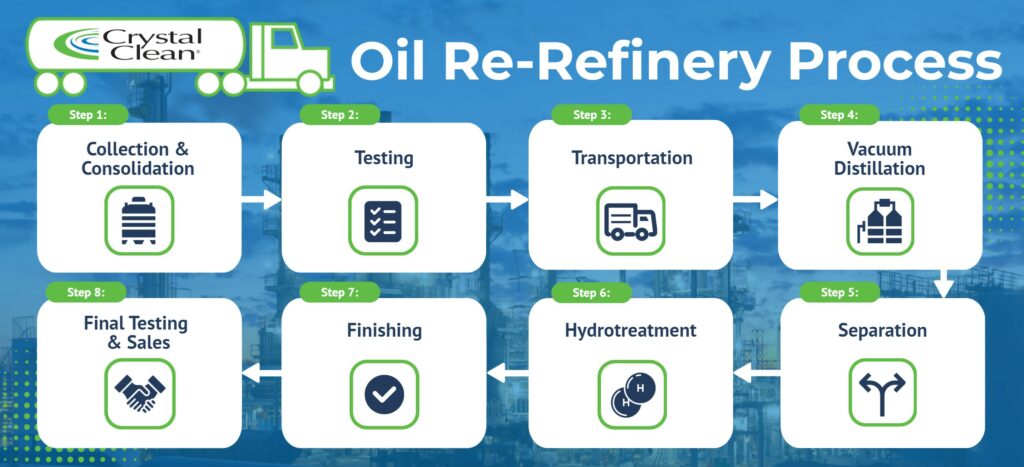
The re-refining process begins as soon as the used oil arrives at the facility. First, it goes through a set of rigorous tests to confirm it meets the requirements to become a useable base oil. Once all the boxes are checked, the used oil is pumped to the vacuum distillation unit. This unit heats the oil under vacuum, which lowers the boiling point and allows the oil to become vaporized. As this gas is produced, this in turn allows vacuum gas oil (VGO) vapor to be separated from the residue or vacuum tower asphalt extender (VTAE). The VGO vapor is condensed and cooled before being pumped to the hydro treatment. Different oil types are separated into three distinct products during this process dependent on the boiling temperature: vacuum gas oils (VGO), light distillate fuels (LDF), and vacuum tower asphalt extender (VTAE). Each of these products go to a different part of the facility to start a separate journey to become a usable product.

Vacuum gas oils undergo further re-refining to become base oil through a process called hydrotreatment. During hydrotreatment, the VGO is treated with hydrogen gas at high temperatures and pressures to remove contaminants. The hydrogen reacts with the impurities, converting them into stable compounds that can be separated and removed. The result is a cleaner, higher-quality base oil that can be further processed into lubricants or other valuable products. Hydrotreatment is essential for ensuring that the recycled oil meets strict quality standards and can effectively replace virgin oil in various applications. Light distillate fuels collected during the distillation process possess unique properties that make them an excellent sustainable energy source. The vacuum tower asphalt extender can be found remaining at the bottom of the vacuum distillation unit. It has many useful properties such as flexibility, waterproofing, and adhesion that make it an ideal binding agent for producing roofing shingles and asphalt pavement.

Re-refining is the sustainable way to manage used oil. By recycling used oil at Crystal Clean’s re-refinery, we make oil into a renewable resource, creating a variety of new base oils and materials used to construct homes and roads in local communities. This transformation not only showcases the innovative potential of re-refining but also highlights the significant environmental and economic benefits of recycling used oil.

For mor­e information about Crystal Clean’s re-refining process and products, visit here.

Contact Us

At Crystal Clean, sustainability and innovation work hand in hand. Our state-of-the-art oil re-refinery in Indianapolis, Indiana, is permitted to process up to 75 million gallons of used oil each year, transforming it into high-performance fuels and base oils that support a wide range of industries.

From lubricant blenders and asphalt producers to industrial manufacturers, Crystal Clean’s re-refined products deliver the performance, reliability, and consistency our customers depend on while supporting a cleaner and more sustainable future.

LDF – Light Distillate Fuel

Light Distillate Fuel (LDF) is a clean-burning fuel used across industrial and manufacturing applications. As a recycled, renewable product, LDF provides dependable energy output while helping customers reduce their reliance on virgin petroleum.

By capturing value from used oil, Crystal Clean’s LDF turns a potential waste stream into a practical, sustainable energy resource.

VTAE – Vacuum Tower Asphalt Extender

Vacuum Tower Asphalt Extender (VTAE) is a heavy, viscous product used in asphalt blending and road construction. It enhances pavement flexibility, durability, and performance, making it a preferred choice for asphalt manufacturers seeking a reliable, cost-effective solution.

VTAE replaces traditional virgin asphalt extenders with a re-refined alternative that lowers environmental impact without compromising quality to support a more sustainable infrastructure.

HTLF – Hydrotreated Low Flash Fuel

In Crystal Clean’s Hydrotreater Unit (HT), Hydrotreated Low Flash Fuel (HTLF) is produced as part of the re-refining process that upgrades Vacuum Gas Oil (VGO). This light, refined fuel is highly flammable and offers clean combustion with minimal odor, making it well-suited for industrial heating and blending applications.

HTLF delivers consistent performance while helping businesses minimize emissions and meet modern efficiency standards.

HTLS – Hydrotreated Low Sulfur Fuel

Hydrotreated Low Sulfur Fuel (HTLS) is anothe25198r fuel product from the Hydrotreater that meets stringent environmental requirements. With a significantly reduced sulfur content, HTLS provides an environmentally responsible option for commercial and industrial use.

Its stability and cleanliness make it ideal for customers seeking a balance between performance and compliance with clean fuel standards.

HCC 80 – Group II Base Oil

Crystal Clean’s HCC 80 Group II Base Oil is a mid-viscosity, high-purity base oil designed for use in a wide range of lubricants — from industrial fluids to automotive and marine formulations. It offers excellent oxidation stability, low volatility, and superior cleanliness, ensuring long-term performance and reliability.

With its consistent properties and compatibility with major additive systems, HCC 80 helps lubricant blenders create finished products that meet demanding operational standards.

HCC 150 – Group II Base Oil

Our flagship HCC 150 Group II Base Oil delivers the highest quality and consistency, exceeding major industry standards — including API SP, ILSAC GF-6, and API CK-4/SM when blended with additives from leading suppliers.

Beyond performance, HCC 150 represents a significant environmental advantage. A third-party verified study by ClimeCo found that Crystal Clean’s HCC 150 re-refined base oil has a 77% lower greenhouse gas footprint compared to virgin base oil. By choosing HCC 150, customers gain a proven, sustainable alternative that performs to the highest specifications while supporting carbon reduction goals.

Quality, Performance, and Responsibility in Every Product

Every Crystal Clean product undergoes rigorous laboratory testing to ensure it meets or exceeds industry specifications. Our focus on quality, reliability, and customer satisfaction means every gallon we produce supports the highest standards of performance and environmental stewardship.

From fuels that power industry to base oils that drive efficiency and sustainability, Crystal Clean’s re-refined products are transforming how businesses think about resource recovery.

Learn more about how Crystal Clean’s re-refined products can support your blending, manufacturing, and sustainability goals and join us in advancing a cleaner, smarter future.

Contact Us